
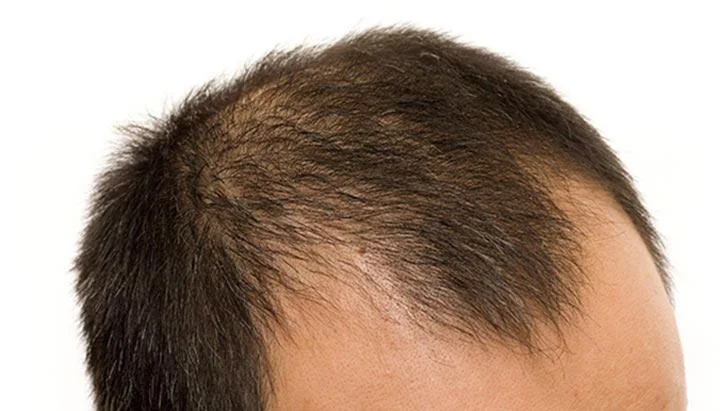
Male pattern baldness does occur in Native American, First Nations, and Alaska Native men. However, limited research suggests it is generally less common and often starts later than in men of European ancestry. It is not absent, and individual risk varies widely, especially with mixed ancestry and family history.
What is male pattern baldness?
Male pattern baldness, or androgenetic alopecia, is a hereditary condition where hair follicles on the scalp gradually shrink and produce thinner hairs over time. The process is driven by sensitivity of follicles to dihydrotestosterone (DHT), a hormone made from testosterone by the enzyme 5-alpha reductase.
Androgenetic alopecia is the most common cause of hair loss in men and results from genetically programmed follicle miniaturization in response to androgens like DHT (American Academy of Dermatology).
In predisposed individuals, DHT shortens the hair growth phase and progressively miniaturizes follicles on the temples, hairline, and crown, creating the characteristic patterns described by the Hamilton–Norwood scale. Treatments target this pathway by reducing DHT or enhancing follicle activity.
How common is male pattern baldness in different populations?
Prevalence rises with age in every population, but the rate and typical age of onset differ by ancestry.
- European ancestry (White men): Studies consistently report high lifetime prevalence, with many showing visible hair loss in a majority of men by older ages. StatPearls summarizes that up to about three quarters of White men may show some degree by late life (StatPearls).
- East and Southeast Asian ancestry: Population surveys in China, Japan, Korea, Thailand, and Singapore show lower overall prevalence and later onset compared with White men (DermNet NZ).
- African ancestry: Available studies suggest rates that are similar to or modestly lower than those seen in Europeans, though data vary by cohort and methodology (StatPearls).
Prevalence and typical age of onset vary by ethnicity, with men of East Asian ancestry generally affected less often and later in life than men of European ancestry (DermNet NZ).
Where do Indigenous peoples of the Americas fit? Direct, large-scale epidemiologic studies focused specifically on Native American, First Nations, and Alaska Native men are scarce. Given the ancestral connection of most Indigenous peoples of the Americas to East Asian populations, many clinicians and researchers infer a lower average prevalence and later onset than in European ancestry groups. But because rigorous, representative surveys are limited, any estimate should be considered provisional.
What do we know about Native American, First Nations, and Alaska Native men?
Evidence comes from three main sources, each with caveats:
- Clinical observation: Dermatologists and community reports often note fewer cases and later onset in Indigenous men compared with European ancestry men. Observations can be biased by access to care and sample size.
- Comparative population data: East Asian cohorts show lower and later androgenetic alopecia, and many Indigenous groups share substantial East Asian ancestry. This supports, but does not prove, lower average risk.
- Genetics: Male pattern baldness risk is polygenic. Key loci include the androgen receptor (AR) gene on the X chromosome and variants near EDA2R, among many others identified in large genome-wide association studies. Risk variant frequencies differ among populations, contributing to prevalence differences (MedlinePlus Genetics: AR gene) (StatPearls).
Bottom line: the condition is present in Indigenous populations, likely at lower average frequency than in European ancestry populations, but high-quality, Indigenous-led prevalence studies are still needed to quantify the difference.
Why do scalp baldness and beard/body hair sometimes go together?
Many people notice that men who thin on the scalp often grow thick beards. This pattern has a biological basis but is not a rule.
- DHT has different effects on different follicles. In beard, chest, and body areas, DHT can stimulate thicker hair growth. In scalp areas sensitive to androgens, DHT promotes miniaturization and thinning.
- Sensitivity is genetically programmed. The same hormone can cause opposite outcomes because follicles express different receptors and signaling pathways.
- Variation is normal. Some men with minimal body hair still thin on the scalp, and some with dense body hair never develop baldness.
These patterns reflect androgen biology and follicle sensitivity, not a universal one-to-one correlation.
What determines individual risk and what can you do?
- Genetics: Heritability is high, and risk is polygenic. Family history on both sides matters because key variants are on the X chromosome and autosomes (StatPearls).
- Age: Risk increases with age in all groups.
- Ancestry: Population-level differences shift average risk but do not predict any one person’s outcome.
Evidence-based treatments can slow or partially reverse thinning in many men:
- Topical minoxidil increases follicle activity and can thicken hair with continued use.
- Oral finasteride reduces DHT by inhibiting 5-alpha reductase type 2, slowing miniaturization. Discuss benefits and risks, including potential side effects, with a clinician.
The American Academy of Dermatology outlines how dermatologists diagnose androgenetic alopecia and choose therapies (AAD). Because traction alopecia and other conditions can mimic pattern hair loss, a proper exam is useful, especially in communities where hair practices vary.
What are the limitations of the evidence on Indigenous hair loss?
Several factors complicate firm conclusions:
- Underrepresentation: Indigenous peoples are underrepresented in dermatology research, including in large genetic studies.
- Heterogeneity: Native American, First Nations, and Alaska Native communities are diverse, with different ancestries, histories, and admixture patterns. A single prevalence number will not fit all groups.
- Access to care and reporting: Differences in access to dermatology services can skew clinical impression versus true prevalence.
Claims that male pattern baldness “doesn’t affect” Indigenous men are inaccurate. A more defensible statement is that it appears less common on average, but rigorous, community-led studies are needed to measure how much less common and why.