
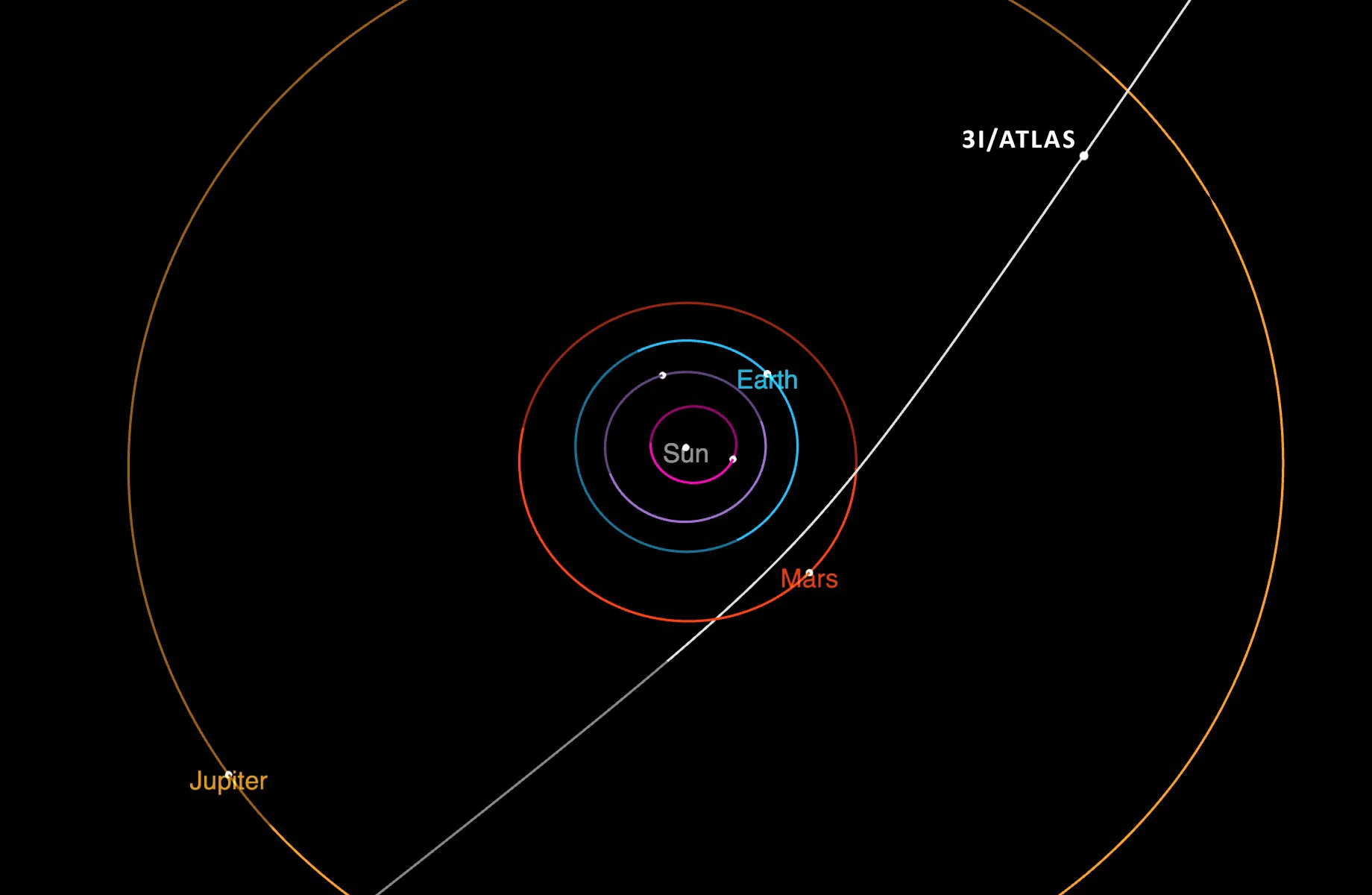
Comet 3I/ATLAS is an interstellar comet on a hyperbolic path that passed through our solar system in 2025. NASA and partner observatories find it to be carbon rich, with abundant carbon dioxide and some carbon monoxide, and water detected only as it moved closer to the Sun. It posed no threat to Earth, staying about 1.8 astronomical units away, and it will not return.
What is comet 3I/ATLAS?
Comet 3I/ATLAS is the third known interstellar object observed passing through our solar system, discovered by the ATLAS survey telescope on July 1, 2025. It is classified as interstellar because its trajectory is strongly hyperbolic, meaning it does not follow a closed orbit around the Sun. When its path is traced backward, it originates from beyond the solar system (NASA 3I/ATLAS overview).
3I/ATLAS came no closer to Earth than about 1.8 AU, roughly 170 million miles, and reached perihelion near 1.4 AU around Oct. 30, 2025 (NASA).
It is only the third interstellar visitor found after 1I/ʻOumuamua and 2I/Borisov. The naming follows the International Astronomical Union’s interstellar sequence, where the “I” denotes interstellar and “3” indicates the third such object (Minor Planet Center MPEC on I-designations).
How was 3I/ATLAS discovered and observed?
The NASA-funded ATLAS survey first reported 3I/ATLAS to the Minor Planet Center, with pre-discovery data extending back to mid-June 2025. Once identified, a broad network of missions and observatories coordinated to track it.
- Hubble Space Telescope imaged the coma and helped constrain the nucleus size.
- James Webb Space Telescope used spectroscopy to probe molecules in the coma.
- SPHEREx collected infrared data across many wavelengths.
- Several heliophysics and planetary missions captured complementary views, including STEREO, Parker Solar Probe, PUNCH, SOHO, Lucy, Psyche, MAVEN, MRO’s HiRISE, Perseverance, and Europa Clipper (NASA 3I/ATLAS timeline).
Nearly 20 missions and research teams coordinated observations of 3I/ATLAS to track its brightness, gas and dust activity, and trajectory (NASA 3I/ATLAS hub).
This coordinated campaign allowed scientists to observe the comet both before and after perihelion and across a wide range of distances and viewing geometries, something that was not possible for 1I/ʻOumuamua.
What is comet 3I/ATLAS made of?
Early results point to a carbon-rich comet. Spectra showed strong carbon dioxide in the coma, with some carbon monoxide. Water emissions became more apparent only as the comet approached the Sun. Trace metals such as nickel and iron have also been detected in the coma, which is common in comets (NASA).
Unlike many solar system comets that develop prominent comae inside about 3 AU, 3I/ATLAS showed significant gas activity at larger distances, consistent with CO2 and CO ices that sublimate in the cold outer regions of planetary systems.
These signatures suggest 3I/ATLAS likely formed in the cold outer reaches of its home system, where CO2 and CO ices can accumulate. That environment, and dynamical interactions such as giant planet migration, make small icy bodies more likely to be ejected into interstellar space. The chemistry provides a rare sample of planet-forming ingredients from another star system, a key motivation for intensive study by Hubble, Webb, SPHEREx and others (JWST mission, SPHEREx).
How big is 3I/ATLAS?
Hubble photometry, which measures how much light the comet reflects, indicates a nucleus somewhere between a few hundred meters and a few kilometers across. As of August 2025, NASA reported an upper limit of about 5.6 kilometers in diameter, with the nucleus possibly as small as roughly 440 meters. The range remains broad because measurements must disentangle light from the coma, the surrounding cloud of gas and dust (NASA 3I/ATLAS).
Typical cometary densities are low, around 0.5 grams per cubic centimeter, which implies a loosely bound, porous body. Continued analysis of post-perihelion observations will refine both size and mass estimates.
Where did it come from, and will it return?
Incoming radiant calculations place its approach direction toward the constellation Sagittarius, but pinpointing a specific home star is unlikely. Only a subset of nearby stars have sufficiently well known past positions and velocities to trace an individual small body back reliably, especially after long interstellar travel and potential stellar encounters (NASA 3I/ATLAS).
3I/ATLAS is on a hyperbolic escape trajectory, so it will depart the solar system once it moves beyond the Sun’s gravitational influence. It will not return on any human timescale.
Is 3I/ATLAS dangerous or artificial?
No. Its minimum distance to Earth was nearly twice the Earth–Sun distance and its mass is far too small to perturb planets at those ranges. All available observations of its motion and activity are consistent with a natural comet undergoing solar heating, sublimation, and jet-driven dust release. NASA emphasizes that mission data are publicly available and that 3I/ATLAS appears to be exactly what it looks like, a natural interstellar comet (NASA, Hubble).
Why does 3I/ATLAS matter for astronomy?
Interstellar objects are physical samples of other planetary systems. Their compositions capture conditions in distant protoplanetary disks, offering clues about how planets form elsewhere. With the Vera C. Rubin Observatory’s Legacy Survey of Space and Time expected to increase discovery rates, studies suggest we may find on the order of one interstellar visitor per year, although uncertainties remain large (Planetary Science Journal study).
Because these objects move quickly and are visible for only a short time, agencies are exploring new mission concepts. ESA’s Comet Interceptor will wait in space to fly by a pristine long-period comet or a future interstellar object, capturing multi-view measurements during a rapid encounter.