
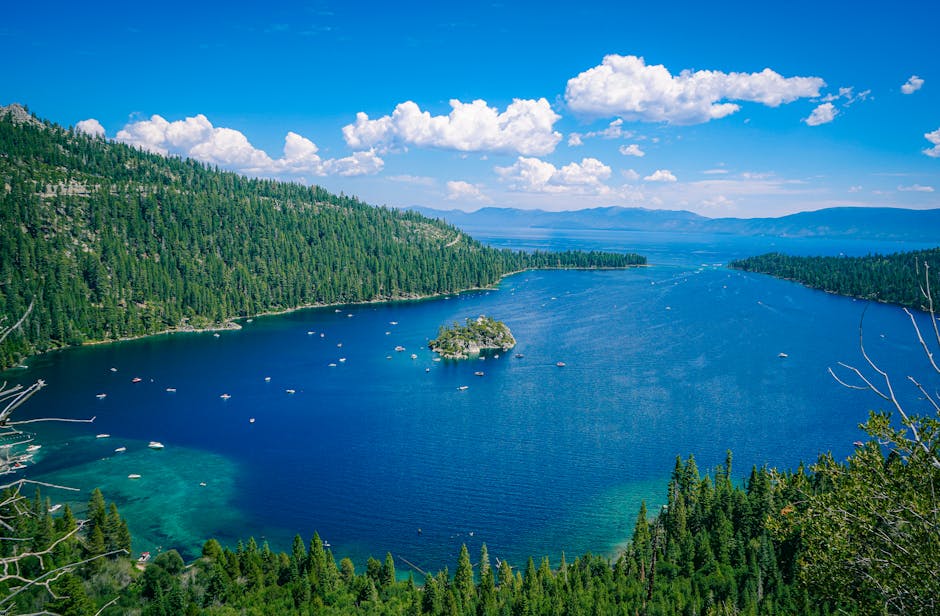
It is literally impossible to put all the oil humanity has ever extracted into a single container, but we can estimate its volume. Using global production data compiled by researchers at Visualizing Energy, cumulative world oil extraction through 2023 corresponds to roughly 240 cubic kilometers of crude oil, or about 2.4 × 10¹⁴ liters. That means all the oil ever pumped from the ground would fill a container a bit larger than Lake Tahoe and somewhat smaller than Lake Erie, two well known North American lakes used as reference points for volume.
Put another way, if you turned all that oil into a single waterfall, it would pour at today’s global consumption rate of roughly 200 cubic meters per second for more than 37,000 years before the container ran dry. That scale is hard to visualize, but it highlights both how deeply the modern world has relied on oil and why debates about reserves, depletion, and climate impacts matter so much.
How much oil has humanity extracted so far?
The best available estimate for how much oil has been extracted comes from long term global production statistics converted into energy units. A recent analysis by Visualizing Energy, which draws on the Energy Institute’s Statistical Review of World Energy and other historical datasets, calculates cumulative oil production through 2023 at about 9000 exajoules of primary energy.1
To turn that energy figure into a physical volume, we need a standard energy content per unit of crude oil. The U.S. Energy Information Administration’s conversion factors indicate that an average barrel of crude oil in recent U.S. production contains roughly 5.7 million British thermal units (Btu), equivalent to about 6.0 gigajoules of energy.2 Dividing total cumulative energy by energy per barrel, and then converting barrels to liters, yields a global cumulative oil volume on the order of 2.3 to 2.4 × 10¹⁴ liters, or about 240 cubic kilometers.
These numbers depend on averaging over different crude qualities and on how far back the production records are reconstructed, so no single figure is exact. However, independent reconstructions by energy historians and statistical agencies converge on a similar range, giving reasonable confidence that humanity has extracted oil volumes comparable to a mid size Great Lake.
Across roughly 160 years of industrial oil production, humans have likely pumped on the order of 240 cubic kilometers of crude from underground reservoirs worldwide.
How does that compare to a lake or sea?
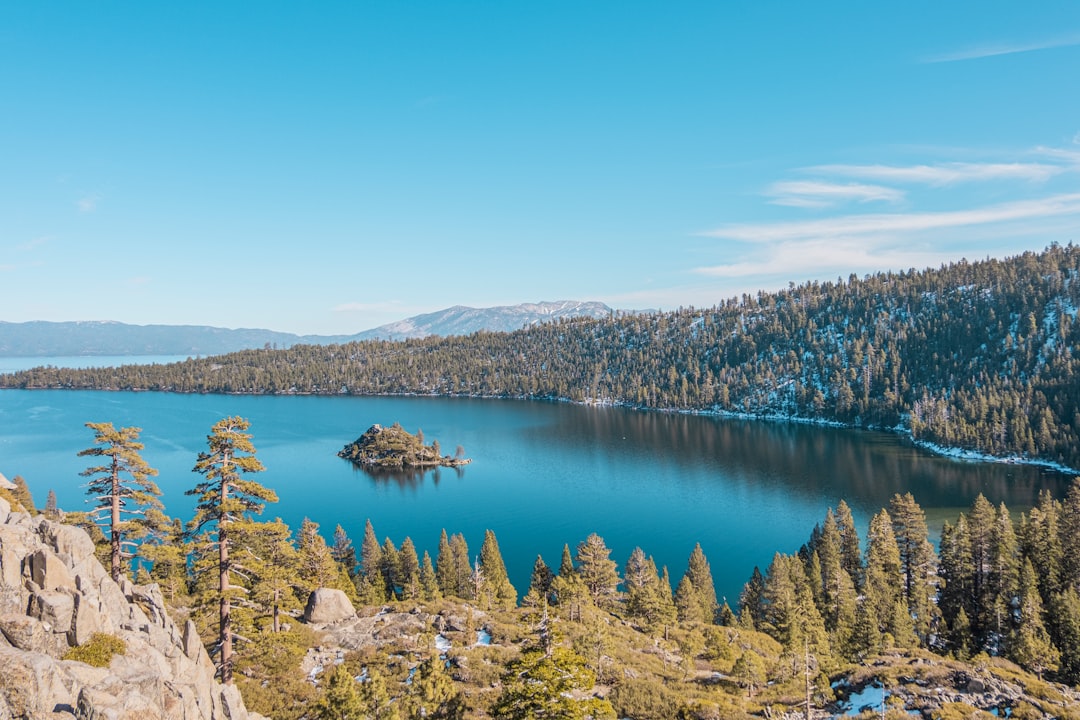
Oil is usually measured in barrels, not lake sized volumes, so comparing to familiar water bodies helps. Two well characterized North American lakes provide useful benchmarks:
Placing an estimated ~240 km³ of extracted oil between these reference points shows that:
- All the oil ever pumped would overfill Lake Tahoe by roughly 60 percent.
- It would amount to about half of Lake Erie’s volume.
So if you insist on a single “container,” imagine a new lake somewhat larger than Lake Tahoe but still clearly smaller than Lake Erie, filled entirely with crude oil. That is the approximate physical footprint of humanity’s historical oil production.
To connect this to daily use, consider the flow rate. Current global oil consumption is about 100 million barrels per day, which converts to roughly 200 cubic meters per second of liquid oil.5 Some medium sized waterfalls, such as Zongo Falls in the Democratic Republic of Congo or Rusumo Falls on the Rwanda Tanzania border, carry water at comparable flow rates. At that pace, it would take more than three dozen millennia to pour the entire historical volume of extracted oil over the edge.
If you picture a waterfall the size of a substantial African river rapid, flowing nonstop for tens of thousands of years, you have a rough sense of how much oil the world has already used.
How do we estimate oil volume from energy and barrels?
The estimate relies on a chain of standard conversions that energy analysts use routinely. The steps are straightforward but worth unpacking, because they explain why reputable sources can quote slightly different totals while agreeing on the overall scale.
1. Start from cumulative energy in oil
Historical oil production is often reported in energy terms, especially when comparing to other fuels. Visualizing Energy’s reconstruction, based on the Energy Institute’s long running Statistical Review, puts cumulative world oil production at about 9,000 exajoules (EJ) as of the early 2020s.1 One exajoule is 1018 joules, so this is an enormous energy quantity.
2. Convert energy to barrels
The U.S. EIA’s energy conversion tables show that a typical barrel of crude oil averaged roughly 6.0 gigajoules (GJ) of heat content in recent data, though the exact value can vary with crude type and over time.2 Dividing total energy by energy per barrel gives the total number of barrels produced historically:
- 9,000 EJ ÷ 6 GJ per barrel = about 1.5 × 10¹² barrels.
This figure is in line with independent estimates of cumulative oil production made by petroleum geologists and by the International Energy Agency, which also place historical output in the low trillions of barrels.
3. Convert barrels to liters and cubic kilometers
By definition, one standard barrel of oil contains 42 U.S. gallons, or about 159 liters. Multiplying the approximate 1.5 trillion barrels by 159 liters per barrel yields:
- 1.5 × 10¹² barrels × 159 L per barrel ≈ 2.4 × 10¹⁴ liters.
There are 1012 liters in a cubic kilometer of fluid. Dividing by this factor gives around 240 km³, the figure discussed above. Using slightly different average energy content per barrel or somewhat different production totals can move the result by perhaps 10 to 20 km³ in either direction, but the “between Lake Tahoe and Lake Erie” comparison remains robust.
Note that this is oil extracted, not oil still present underground in known fields or yet to be discovered. Reservoirs typically retain a substantial fraction of their original oil in place, because it is either uneconomic or technically difficult to produce the final portions, so the volume of oil that once existed in accumulations is considerably larger than the produced volume.
How much oil is left, and what do “reserves” really mean?
It is natural to wonder, after hearing that we have already pumped an oil lake the size of a mid size Great Lake, how much more might be left. Here, the key is to understand that terms like “reserves” do not mean “all the oil in the ground.” They refer to a subset that can be produced economically under current conditions.
According to the Energy Institute’s Statistical Review of World Energy 2023, proven global oil reserves are currently on the order of 1.6 to 1.7 trillion barrels.5 This figure is comparable to or slightly larger than the estimated volume already produced, which is why many charts show cumulative production and remaining reserves as similar blocks. However, proven reserves are defined as oil that is “reasonably certain” to be recoverable from known fields with existing technology at current prices, not as a fixed physical ceiling.
Because of that definition, reserve numbers can increase over time even as we keep producing oil. New discoveries, improved recovery techniques, and higher market prices can all move oil from the category of “known but not economic” into “proven reserve.” This is why earlier public claims that “we will run out of oil in a few years” have repeatedly failed. They implicitly treated proven reserves as a constant tank being drained, rather than a moving target shaped by geology, technology, and economics.
Reserve life statistics like “40 years of oil left” are snapshots based on current reserves and current production. They do not mean oil supplies suddenly go to zero after that time.
From a climate perspective, however, the more pressing problem is not running out of oil, but the opposite: burning even a large fraction of known reserves would emit far more carbon dioxide than is compatible with well below 2 °C of global warming. Multiple analyses by the Intergovernmental Panel on Climate Change and by independent research groups conclude that a significant portion of fossil fuel reserves must remain unburned to meet internationally agreed climate targets.6
Why does the scale of extracted oil matter?
Thinking about all the oil ever pumped as a Lake Tahoe sized volume is more than a curiosity. It illuminates several key points about the modern energy system and its environmental footprint:
- Energy density vs. volume. Oil packs far more usable energy into each liter than water. That is why a “mere” 240 km³ of oil has powered global transport, industry, and household energy use for over a century and a half. The same volume of water in a hydropower reservoir would yield orders of magnitude less energy.
- Infrastructure scale. Extracting, transporting, refining, and burning this much oil has required a vast global infrastructure of wells, pipelines, tankers, refineries, vehicles, and storage tanks. The imaginary oil lake is a reminder of the collective physical footprint of that network, not just the fuel in any one tank.
- Climate and pollution impacts. Burning roughly 1.5 trillion barrels of oil has emitted on the order of 500 to 600 billion tonnes of CO₂ historically, based on standard emissions factors from the IPCC.6 That cumulative carbon release is a major contributor to the observed increase in atmospheric CO₂ and associated warming, as well as to related issues like ocean acidification and air pollution.
- Transition implications. Finally, appreciating the sheer size of the historical oil “lake” underscores the scale of the energy transition. Replacing that flow with low carbon alternatives requires not just building new generation capacity, but also transforming vehicles, industrial processes, and grids that have been optimized around liquid hydrocarbons for generations.
So while no one is literally filling a basin the size of Lake Tahoe with crude, thinking in those terms provides an intuitive way to grasp how deeply oil has been woven into modern civilization and why changing course is both challenging and urgent.