
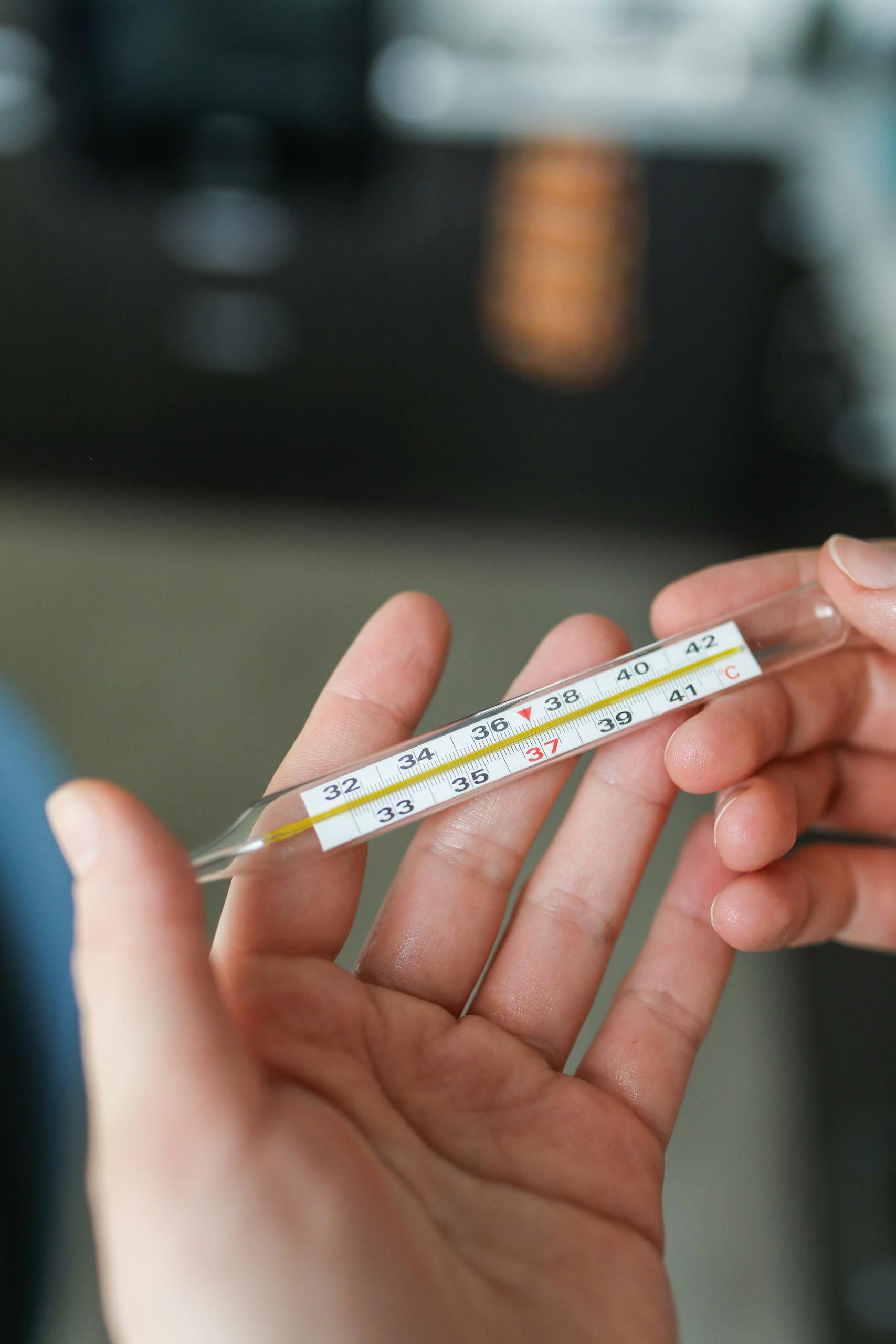
Your brain does not carry a NIST‑traceable thermometer. It does something stranger. From birth, without ever seeing a Celsius scale, you stabilize around a narrow thermal zone where your chemistry works best, sweating and shivering in a choreography you never consciously learned.
That is why the folk memory of “normal” as 98.6 °F persists, even though it was never a magic number. It came from a 19th‑century German physician who popularized temperature charts and reported a mean of 37 °C, later rounded into an oddly precise 98.6 in Fahrenheit conversion. The precision is false comfort, as metrologists would point out: precision is not the same as accuracy, and rounding 37.0 °C to one decimal in Fahrenheit suggests a certainty the original number never had. If you need a refresher on that distinction, the accuracy versus precision entry is a good primer.
“Normal” is a range, typically 36.5–37.5 °C (97.7–99.5 °F), not a single point on a dial.
Modern data sharpen the story. A 2020 analysis showed average U.S. body temperature has drifted downward since the 1800s, likely reflecting lower chronic inflammation and changed living conditions, not a species‑wide malfunction. The average oral temperature in some contemporary cohorts sits around 36.4 °C (97.5 °F). You can read those updates in eLife and a 2023 JAMA Internal Medicine study that mapped usual outpatient ranges.
The thermostat you grow, not the number you read
So how does a body “know” where to hold? It does not compare itself against a calibrated reference. The preoptic area of your hypothalamus integrates signals from central and peripheral thermoreceptors, then pushes a suite of effectors, from skin blood flow to sweat glands and skeletal muscle tone, to minimize error from an internally encoded target. A concise overview sits in the StatPearls physiology chapter.
The hardware looks nothing like a bathroom thermometer. Temperature‑sensitive ion channels in neurons change their firing rate as molecules jiggle faster or slower. These include families that also make chili peppers feel hot and menthol feel cool, repurposed by evolution to detect real heat and cold. Their biophysics, plus the wiring of warm‑sensitive and cold‑sensitive neurons in the preoptic area, create a stable operating point without any external scale. In control‑theory terms, some outputs (sweat or no sweat, shiver or not) behave like a simple bang‑bang controller, switching on and off around thresholds, while others are graded, more like proportional control. The whole circuit behaves as a robust, multi‑effector governor, not a single knob.
There is no tiny ice bath and boiling pot in your head. The “set point” emerges from ion channels, synapses, hormones, and evolution.
Why this zone at all? Enzyme kinetics and membrane physics pin it. Human biochemistry, optimized over millions of years of endothermy, runs with peak reliability near this temperature band. Warmer increases reaction rates but threatens protein stability and oxygen delivery. Cooler preserves stability but slows reactions and impairs nervous conduction. Evolution selected bodies whose decentralized thermostats kept that trade‑off in the sweet spot across climates, not because Earth conveniently matched us, but because organisms that could hold their core steady survived to reproduce.
When the target moves
Crucially, the target is not static. The hypothalamus raises or lowers it when conditions demand, and the periphery follows.
- Infection and inflammation. Cytokines such as IL‑1 and IL‑6 induce COX‑2 and prostaglandin E2 in hypothalamic circuits, which lift the set point, creating fever and chills as the body “aims higher.” That mechanism, summarized in StatPearls, is why antipyretics that block prostaglandins lower fever.
- Hormones and cycles. After ovulation, progesterone nudges the baseline up, which is why fertility awareness methods track a small but reliable basal temperature rise. During menopause, the comfort zone between the upper and lower thresholds narrows, so minor internal wiggles trigger hot flashes and chills.
- Thyroid and metabolism. Excess thyroid hormone cranks up heat production and raises resting temperature, while hypothyroidism flattens metabolism and cools it.
- Aging. Baselines tend to be lower in older adults, who also mount blunted fevers and regulate more slowly in heat and cold, as reviewed in this NIH‑indexed mini‑review.
- Environment. Thermoregulation is powerful but not infinite. The limiting factor is often humidity, captured by wet‑bulb temperature. Recent lab work suggests critical thresholds for sustained exposure are closer to about 31 °C in some conditions, below the oft‑quoted 35 °C, underscoring the stakes of extreme heat. See the 2022 data in the Journal of Applied Physiology.
All of this helps explain why one person feels wrecked at 99.0 °F while another shrugs. Your control loop stabilizes around your biology, pushing you back toward your personal zone, not anyone else’s number on a clinic wall.
The number on your thermometer, and why it misleads
Even if homeostasis is elegant, our measurements are messier. Readings vary by site and method. Oral is convenient but error‑prone if you just sipped coffee, breathed through your mouth, or placed the probe shallow. Ear thermometers are fast and correlate better with brain blood supply, though placement matters a lot. Rectal runs higher and lags during rapid change. The pulmonary artery is the gold standard in the ICU, but not your bathroom.
StatPearls lays out those trade‑offs and warns against overinterpreting single decimals. In other words, resist the false certainty of the “.6” in 98.6. As the body‑temperature overview notes, the daily circadian swing alone is about 0.5 °C. The lowest point tends to land a couple of hours before you wake; the late afternoon is the daily crest. Physically active people often show a larger daily swing, and older adults a smaller one.
Your thermometer reports a moment. Your hypothalamus manages a process.
There is a practical takeaway. Know your baseline. If you usually sit at 36.3 °C (97.3 °F), a reading of 37.2 °C (99.0 °F) late in the day may represent a meaningful change for you, especially with symptoms, even if it does not cross a generic fever threshold. Clinicians increasingly emphasize context and trend, not isolated digits.
One last misconception worth retiring: that water somehow “sets” the number. Water’s high specific heat and latent heat of evaporation are why sweating and blood flow are such effective levers, carrying heat from core to skin and off into air. Those properties make regulation feasible, they do not define the set point. The set point is a property of a living control system tuned by physics, genes, hormones and experience.
Seen that way, the old 98.6 looks less like a law and more like a milestone, a cultural artifact from the dawn of clinical thermometry. The more interesting story is the one your body writes every minute, nudging, dampening, and sometimes shifting its target to keep metabolism in tune with a changing world.