
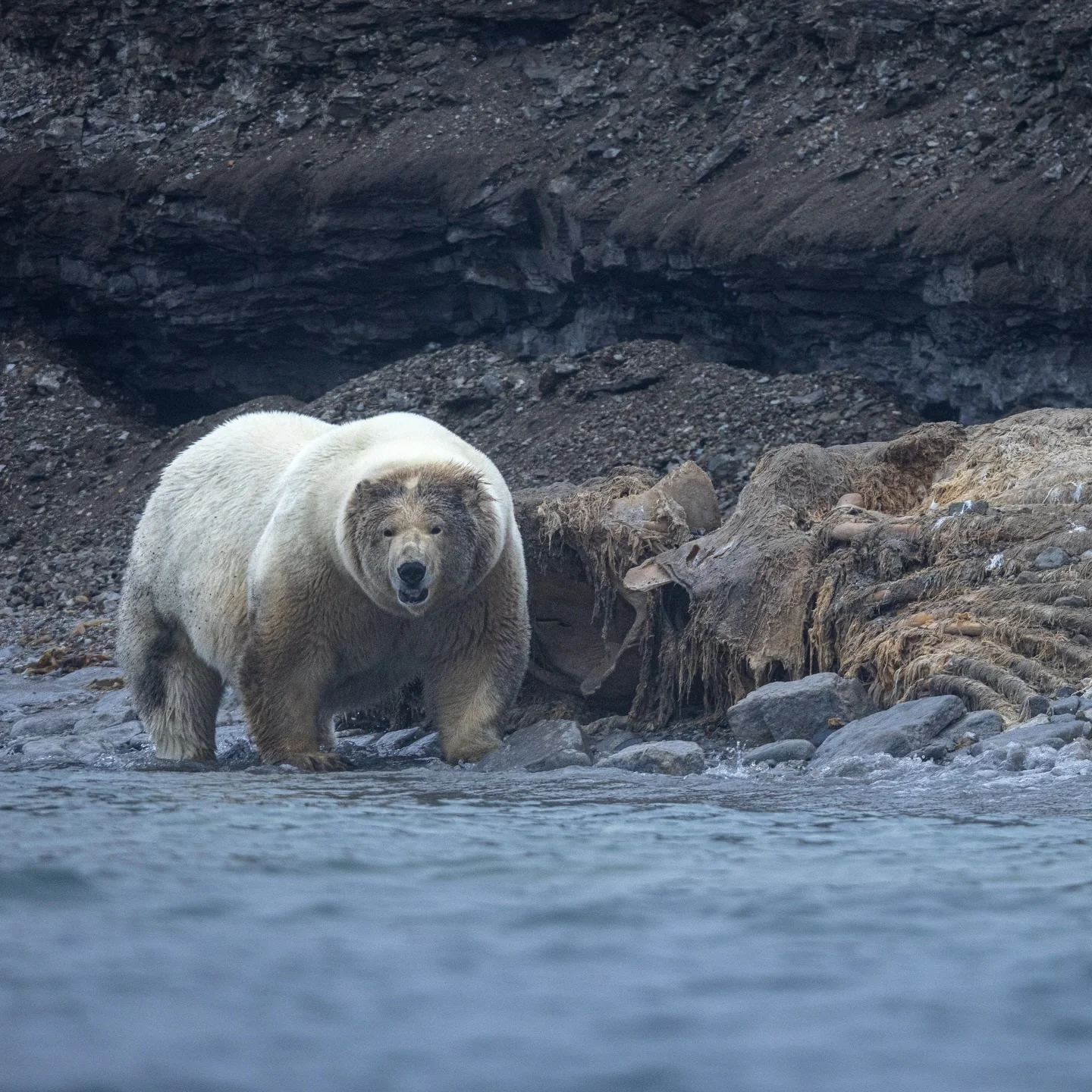
The whale was already dead when the polar bear found it. The photos that followed — a colossal bear, cheeks slicked with blubber, tongue peeking out like a satisfied thief — ricocheted around the internet as a celebration of chonk. It reads as a happy ending. It is also a complicated one.
The images, made near Norway’s high Arctic archipelago of Svalbard, show a bear in extraordinary condition. Social feeds crowned him an absolute unit. Biologists see something else: a reminder that in a warming Arctic, life is increasingly feast or famine. Polar bears are built for famine. They are also built to cash in on a rare feast like a beached whale.
Polar bears do not hibernate; only pregnant females den. Adult males can fast for months, then binge on fat when luck appears. Polar Bears International
Whale carcasses are the Arctic’s emergency rations. Fat is the currency of survival here, and blubber is the platinum card. A single large carcass can feed scores of bears in shifts, day after day, with energy that seals or seabird eggs simply cannot match. Field workers on Svalbard have long watched bears commute to dead whales, sometimes traveling many kilometers for a bite. The bear in those photos looks golden rather than white because polar bear fur often stains with oils and grime, and under certain light their guard hairs skew yellow. It is not a hybrid. There are no brown bears on Svalbard, and confirmed polar–grizzly mixes are rare and mostly documented in the Canadian Arctic, where ranges overlap as the climate changes (National Geographic).
Size gets the clicks. Context matters more. An exceptionally large male polar bear can top 700 kilograms, with a disputed historical outlier reported at roughly a metric ton. Typical adult males run 350 to 600 kilograms, while females are much smaller (Polar Bears International). The animal in these pictures looks enormous because it is. It also looks enormous because this is what success looks like when success is brutally rare.
Feast, famine, and a vanishing platform
Polar bears evolved to hunt seals from sea ice. That platform is shrinking. The Arctic is warming almost four times faster than the global average, a pace that is reshaping the calendar of ice freeze-up and break-up and forcing bears to spend longer on land with fewer options (Nature, 2022). Svalbard is a hot spot within this hot spot. West Spitsbergen has seen dramatic sea-ice retreats, cutting into the time bears can stalk ringed and bearded seals at breathing holes.
What fills the gap are workarounds that mostly do not work. Scavenging reindeer, raiding bird colonies, wandering towns, or finding the occasional washed-up whale — these are patches, not a plan. Studies and monitoring by the Norwegian Polar Institute and others have documented declines in body condition for some subpopulations as fasting seasons lengthen. That does not mean every bear is starving. It does mean that more bears face harder math.
The sight of a single overstuffed bear is not proof the species is thriving. It is proof that one individual hit the jackpot on a day when the market crashed for many others.
There is an irony here. As some whale populations in the North Atlantic slowly rebuild after historic slaughter, more carcasses and strandings may appear. Those carcasses can act as lifelines for bears pushed off the ice. Researchers describe this as a “resource pulse,” a sudden bonanza in a sparse landscape. It is a gift, but an unpredictable one, arriving in the wrong place, at the wrong time, or too close to people.
When a feast brings trouble ashore
Carcasses do not only concentrate bears. They concentrate risk. In Svalbard, where cruise ships and camera lenses are never far, authorities now routinely tow beached whales away from settlements to reduce the chances of a dangerous encounter. The Governor of Svalbard’s safety guidance is blunt: do not approach bears, avoid whale carcasses, and keep distance with rifles only as a last resort (Governor of Svalbard).
That guidance exists because the bears that look goofy and friend-shaped are apex predators with a browsing radius. A carcass can draw animals from far across sea and shore, and a full bear can be as defensive as a hungry one. The photos are disarming. The reality is not.
For anyone still puzzling over internet debates sparked by the images, a few grounded answers help.
- Do polar bears “hibernate” for winter? No. Only pregnant females den, where they give birth and nurse. Males and non-pregnant females remain active year-round, fasting when they cannot hunt (PBI).
- Is this a hybrid? Almost certainly not in Svalbard. Documented polar–grizzly hybrids have come from areas where grizzlies and polar bears overlap in Canada and Alaska, not from the high Arctic islands of Norway (NatGeo).
- Why the color? Polar bear fur is transparent and appears white by scattering light. Oils, algae, and seal blood can tint it cream or yellow, especially on a blubber binge (PBI).
Polar bears are listed as Vulnerable on the IUCN Red List because projected ice loss threatens long-term survival, even as some subpopulations remain stable today. IUCN Red List
Vulnerability is a blunt category for a subtle story. Subpopulations respond differently depending on local ice, human activity, and prey. Svalbard’s bears are not Alaska’s bears. Some will find whales. Many will not. The species’ fate will not hinge on scavenging jackpots. It will hinge on whether sea ice remains a predictable hunting ground.
What this moment actually shows
Look again at the photos and you can see a physics problem disguised as a feel-good post. A body engineered for fat storage is cashing a rare check. The same physiology that lets a bear collapse a seal’s breathing hole with one paw also turns blubber into banked time. That is what success looks like when the ice calendar is working. Without ice, you are watching a savings account and hoping the next deposit arrives before the balance hits zero.
There is a human story in the frame, too. Our appetite took down the whales, then let them partly recover. Our carbon shrank the ice platform, then sent bears ashore to scavenge the whales we barely restored. The photos trigger glee because the bear looks triumphant. They should also trigger a harder question: triumph over what timeline?
Policy moves slowly. Physics does not. If you want fewer bears starving and fewer dangerous encounters at carcasses, you do not start by hoping for more dead whales. You start with the thing that builds the platform under their feet. That is emissions. Everything else in this story is a workaround.
Enjoy the pictures. Celebrate the bear. Then remember what you are seeing. Not a symbol of resilience that renders the science moot. A vivid snapshot of how a supreme hunter survives the Anthropocene, one windfall at a time.