
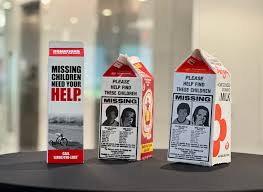
Milk carton kids were missing children whose photos and brief details were printed on milk cartons in the 1980s to enlist the public’s help in finding them. The campaign worked only rarely at directly locating children, with a handful of cases such as Bonnie Lohman’s recognition of herself leading to reunification. It did, however, raise national awareness about missing kids, helped spur policy changes, and eventually gave way to more effective tools like the AMBER Alert system.
Subtitle: The 1980s missing children campaign on milk cartons, how it worked, how often it helped, why it ended, and what replaced it
What were milk carton kids?
Milk carton kids refers to a grassroots, later widely adopted, awareness campaign that put photos of missing children on half-gallon milk cartons in grocery stores and school cafeterias. Independent dairies began experimenting with the idea in 1984, and it spread nationally within a year as the newly formed National Center for Missing and Exploited Children and local law enforcement provided photos and case summaries.
Definition: Milk carton kids were part of a mass public-awareness effort in the mid-1980s that placed missing children’s photos on consumer packaging to prompt tips from everyday shoppers.
The approach emerged alongside new federal attention to missing children, media coverage of high-profile cases, and a growing private-public network aimed at finding long-term missing youth.
How did the milk carton campaign work?
Dairies printed headshots, names, ages, missing dates, and a hotline number on the side panels of milk cartons, often rotating cases regionally. Photos came from police or missing-child organizations and were selected for clarity and relevance to the distribution area. Grocery shelves, school cafeterias, and breakfast tables became daily touchpoints where millions of people would see these faces.
When a child had been missing for years, artists sometimes supplied an age-progressed image to approximate current appearance, a practice that continues today with forensic specialists at the National Center for Missing and Exploited Children.
Did milk carton kids work?
Direct recoveries attributable to milk carton sightings were rare. One of the few well documented examples is Bonnie Lohman, who recognized her own photo, kept from a carton as a “picture,” and, after neighbors saw it, was reunited with her father. In most cases there was no clear, measurable link between a carton sighting and a recovery.
Research and official estimates show that most missing-child cases involve runaways or family abductions, not abductions by strangers. This mismatch limited how often a shopper’s tip could solve a case.
The campaign’s broader effects were real. It helped establish missing children as a public concern, encouraged standardized hotlines and case reporting, and amplified the mission of organizations that still operate today. But as a tool for quickly locating a specific missing child, it was much less effective than later, targeted alert systems.
The Office of Juvenile Justice and Delinquency Prevention’s NISMART research has long estimated that stereotypical kidnappings by strangers are very rare compared to family abductions and endangered runaways. That context helps explain the campaign’s limited direct impact.
Why did the milk carton campaign end?
By the early 1990s the approach faded for a combination of practical and strategic reasons:
- Packaging changed, with plastic jugs and shrink sleeves replacing printed paper cartons.
- Brand and legal concerns grew as dairies sought consistent designs and avoided potentially outdated or sensitive case details.
- Effectiveness questions mounted, since few recoveries could be traced to carton sightings.
- Parents and educators reported that the imagery fed persistent “stranger danger” anxiety among children.
As public safety agencies professionalized their response and technology improved, resources shifted to more targeted and timely alerting systems.
What replaced milk carton kids?
The most important successor is the AMBER Alert, created in 1996 and expanded nationwide in the early 2000s. AMBER Alerts use strict criteria, verified details, and rapid distribution via mobile phones, highway signs, broadcast media, and connected platforms to reach people who can help immediately.
- AMBER Alerts are time sensitive, issued only when law enforcement believes a child is in imminent danger and has descriptive information that can aid a fast recovery.
- Digital photos now distribute instantly across phones, news feeds, and billboards, addressing the old system’s lack of timeliness.
- Age progression and other forensic techniques continue under the National Center for Missing and Exploited Children, improving long-term recovery odds.
Enlisting the public has not gone away, it is more precise and immediate today. That shift is why alerts and coordinated case management outperform static packaging.
What does this mean for child safety today?
Milk carton kids mattered because they helped launch a sustained national response to missing children. The campaign’s limits are also instructive. Broad, untargeted awareness can raise concern but may not solve cases, especially when most involve family abductions or runaways rather than unknown offenders.
For parents and communities, the best takeaway is to focus on evidence-based safety practices, keep current photos of children, and know how to respond quickly if a child goes missing. For policy makers and platforms, continuing to refine alert criteria, distribution speed, and photo quality remains the highest-impact path.