
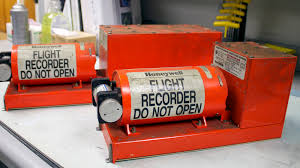
Airplane black boxes are painted bright orange so investigators can find them quickly after a crash. International and national regulations require flight recorders to be finished in a high-visibility color, typically bright orange or yellow, with reflective surfaces and clear labels, which is why they are not actually black. The term survives as a nickname, but the official devices are the flight data recorder and the cockpit voice recorder.
What are airplane black boxes?
“Black box” is a common name for two crash-hardened devices on airliners: the flight data recorder (FDR) and the cockpit voice recorder (CVR). The FDR logs hundreds of parameters such as speed, altitude, control positions, and engine data. The CVR records audio from the cockpit, including pilot headsets and an area microphone. Some aircraft use a combined unit that records both, sometimes called a CVDR or Enhanced Airborne Flight Recorder.
These recorders are mounted where survival is most likely, often near the tail, and are designed to withstand extreme impact, fire, and immersion so investigators can retrieve their data after an accident. See the overview in Flight recorder terminology.
Why are airplane black boxes orange?
The color is a search-and-recovery aid. After a crash, wreckage may be scattered, burned, or submerged. High-visibility paint makes the recorder stand out against debris, vegetation, water, or snow during ground or aerial searches. Reflective tape further increases visibility under flashlight or searchlight.
Regulations call for recorder containers to be colored bright orange or bright yellow, with reflective surfaces, to aid visual detection in debris fields and in water.
In practice, manufacturers almost universally use bright orange, which is why the units are often called high-visibility orange. Labels such as “FLIGHT RECORDER DO NOT OPEN” are applied to assist rescuers and deter tampering.
Are airplane black boxes legally required to be orange?
Yes, authorities require a high-visibility finish. The International Civil Aviation Organization (ICAO) directs high-visibility coloring for crash-protected recorders in Annex 6, and widely adopted performance standards such as EUROCAE ED-112 specify conspicuity features. In the United States, Federal Aviation Regulations explicitly require bright orange or yellow for both devices. For example, see 14 CFR §25.1459 (Flight data recorders) and 14 CFR §25.1457 (Cockpit voice recorders).
EUROCAE ED-112 requires crash-protected recorders to meet conspicuity requirements and to be marked and labeled to facilitate recovery and proper handling by investigators.
Some standards allow bright yellow as an alternative, but modern commercial units are almost always orange.
How are black boxes found after a crash?
Color is one of several locator aids. Recorders also carry an underwater locator beacon (ULB) that emits an acoustic “ping” if submerged, helping search teams triangulate the device under water for a set period, typically 30 days. Investigators combine ULB signals with sonar, remotely operated vehicles, and visual searches, guided by radar tracks and wreckage drift models.
- High-visibility orange paint and reflective tape for visual searches
- ULB acoustic pinger for underwater detection
- Standardized labels to ensure proper handling by recovery crews
For background on locator beacons and survivability features, see the components section of Flight recorder.
Are black boxes indestructible?
No, but they are engineered to survive extreme conditions so the data does. International standards define minimum crashworthiness. ED-112 specifies resistance to severe impact, crush, penetration, fire, and deep-sea pressure.
ED-112 calls for survival of about 3,400 g impact and exposure to temperatures over 1,000 °C for specified durations, among other tests.
Even when the exterior is heavily damaged, the memory module is protected by insulation and robust metals such as stainless steel or titanium. Data recovery labs can often extract usable recordings from units recovered on land or from the seabed.
Why are they called “black boxes” if they are orange?
The nickname predates modern recorders. During World War II, the British referred to secret radar and navigation electronics as “black boxes” because they were housed in dark, non-reflective enclosures. The name later stuck to flight recorders, even after regulators mandated high-visibility paint for recovery. This is distinct from the engineering term “black box,” which describes any system analyzed by inputs and outputs without regard to internal workings. See black box in engineering and flight recorder terminology.