
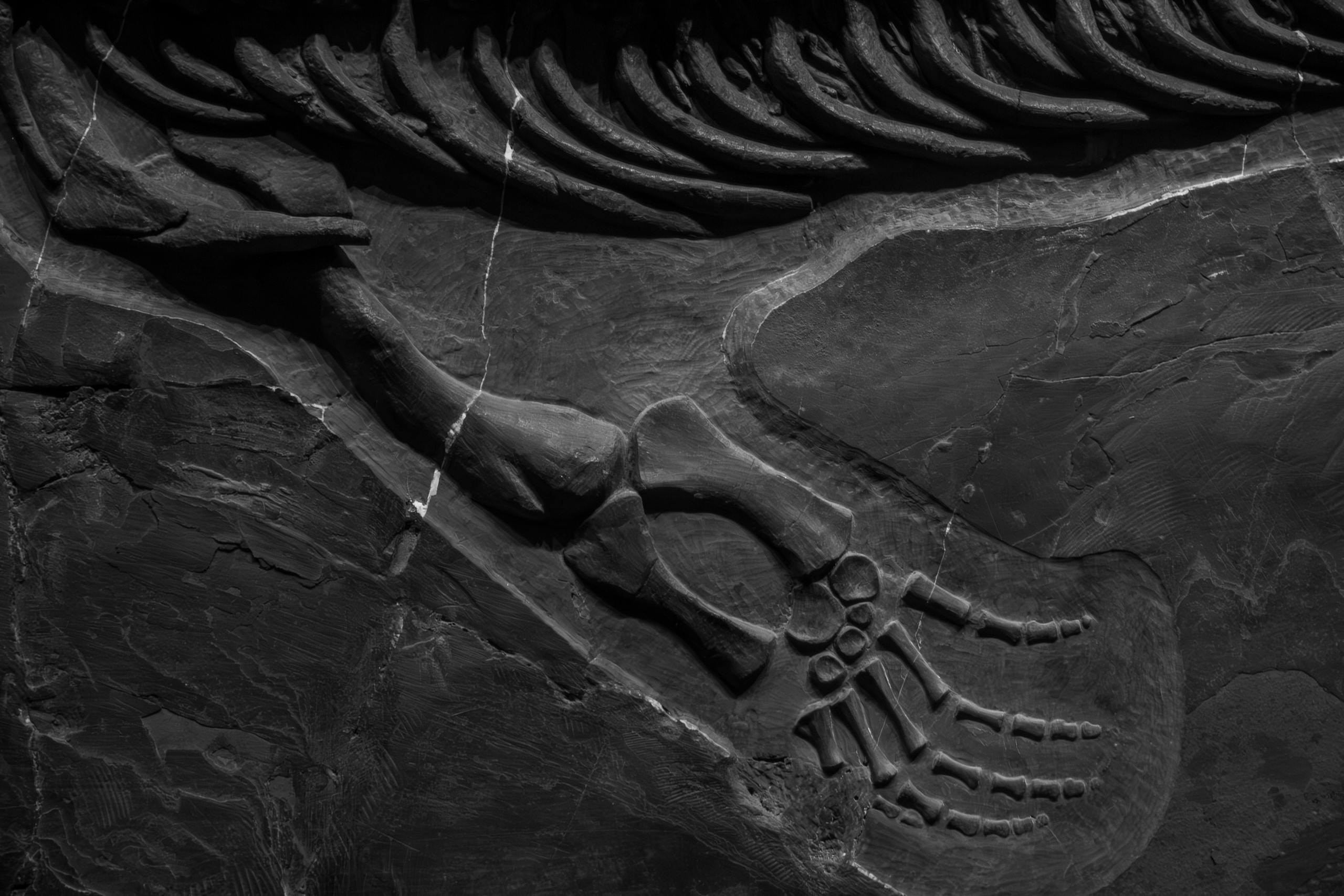
Paleontologists tell when bones are missing by comparing a fossil to other specimens and close relatives, reading the joint surfaces that show where bones articulated, and using the repeated symmetry and serial patterns of vertebrate skeletons. These clues reveal gaps and help estimate how many elements are absent, especially in series like necks and tails. The most reliable counts come from multiple fossils of the same species and from phylogenetic bracketing across related animals.
What is the basic method for spotting missing bones?
Reconstruction starts with comparative anatomy, the study of how skeletons are organized across vertebrates. Limbs follow a conserved pattern, for example one upper bone, two forearm or shin bones, wrist or ankle bones, then digits. Backs are built from repeating vertebrae that change gradually from neck to trunk to tail. Because dinosaurs were vertebrates, they share these basic modules and left-right bilateral symmetry.
- Symmetry: if a left femur is present, a right femur once existed. If one side of the pelvis is preserved, the mirror element is missing.
- Serial patterns: sequences like cervical, dorsal, sacral, and caudal vertebrae change in predictable ways along the column. Abrupt breaks in that progression signal missing pieces.
- Population sampling: dozens of partial skeletons of the same species can collectively reveal the full bone list, even if no single individual is complete.
Complete, articulated dinosaur skeletons are exceptional. Most specimens preserve only a fraction of the full skeleton, so paleontologists rely on repeated anatomical patterns and multiple fossils to fill gaps (Mannion & Upchurch 2010).
How do scientists tell which bones connect to which?
Bones advertise their neighbors through their articulation surfaces and attachment features. These are not generic; they are shaped to the joint or connection they made in life.
- Joint geometry: ball and socket structures, condyles, and concavities on limb bones and vertebrae often match the only partner they could have contacted. For example, the skull’s occipital condyle fits a specific socket on the first neck vertebra.
- Vertebral facets: vertebrae carry zygapophyses, interlocking facets that restrict motion. Adjacent vertebrae have complementary shapes and orientations, which helps order them correctly and spot missing ones between mismatched pairs.
- Specialized processes: tail vertebrae often have haemal arches (chevrons) that hang below, while trunk vertebrae have rib facets. If rib facets suddenly disappear between two preserved vertebrae, intervening elements are likely missing.
- Muscle and ligament scars: ridges and pits show where soft tissues attached. Continuous attachment traces that stop abruptly can indicate a break in the series.
When a pair of bones does not quite meet, consistent spacing and matching wear on articular surfaces can show whether one bone sits directly next to another or if one or more elements are absent between them.
How do paleontologists estimate missing neck or tail vertebrae?
Serial structures like tails and necks change gradually in size and shape along their length. Researchers use these gradients and comparisons to close relatives to estimate total counts and how many pieces are missing.
- Progressive tapering: centra and neural spines typically shorten or thin in a regular trend. If the preserved series ends before the “terminal” morphology appears, remaining vertebrae are inferred and can be estimated from the rate of size change.
- Regional transitions: landmarks such as the last vertebra with ribs, the number of sacrals fused to the pelvis, or where haemal arches first appear help anchor positions along the column.
- Regression from close relatives: closely related taxa with complete or nearly complete tails provide reference counts and proportions, which can be scaled to the specimen at hand. For example, studies of tyrannosaurid tails use preserved sequences and relatives to estimate missing caudals and muscle mass (Persons & Currie 2011).
In serial structures, adjacency is tested by matching articular facets and the trend in shape from one bone to the next. A sudden jump in size or facet orientation usually signals a gap, not true adjacency.
How do multiple fossils and relatives fill the gaps?
The gold standard is to compare multiple individuals of the same species. Bonebeds often preserve many partial skeletons with different pieces intact, which can be combined to map the full complement of bones. When conspecifics are unavailable, scientists use phylogenetic bracketing: if both a species’ close ancestors and close descendants share a trait, the species itself likely had it too.
Phylogenetic bracketing infers missing anatomy by reference to the nearest living or fossil relatives. If both sides of a fossil’s family tree possess a feature, the bracketed taxon probably did as well (UCMP: cladistics overview).
For dinosaurs, the extant bracket is usually birds and crocodilians. This approach strengthens inferences about bone counts, joint types, and even soft tissues when direct evidence is missing.
What are the uncertainties and limitations?
Reconstruction is constrained by biology and the rock record, but it is not guesswork. Scientists document what is preserved, what is inferred, and how confident they are. Limits include:
- Ontogeny: juveniles and adults differ. Bone counts change as elements fuse, such as in the pelvis and skull.
- Individual variation and pathology: extra or missing vertebrae, fused joints, or healed injuries can complicate counts.
- Taphonomy: decay, scavenging, transport, and compression distort or separate bones before burial and fossilization, which can scramble sequences.
- Historical error: classic mistakes like the early Iguanodon thumb-spike placement happened when comparative datasets were small. Modern work mitigates this with larger samples, CT scanning, and explicit, testable justifications in the technical literature.
Museum mounts typically label which bones are original, which are casts, and which are mirrored from the opposite side. That transparency reflects the underlying practice: identify what is known, infer what is missing using repeatable rules, and revise when better evidence appears.
Why this matters for fossil reconstructions
Knowing what is missing and how confidently it is inferred affects body length estimates, posture, and biomechanics. Tail length influences center of mass and locomotion models. Vertebral counts constrain neck flexibility and feeding range. Clear, method-driven estimates help keep those downstream analyses realistic and reproducible.