
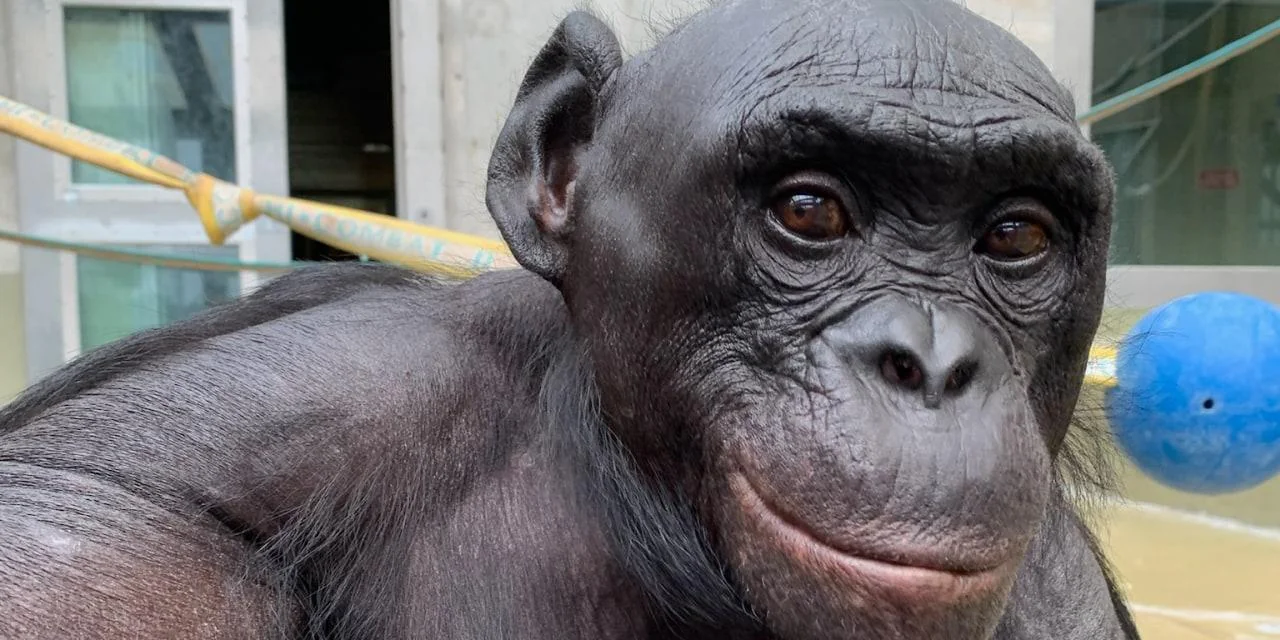
Yes, apes can pretend. New controlled experiments with a symbol-trained bonobo named Kanzi show that a great ape can participate in make-believe scenarios and track the locations of entirely imaginary objects. This goes beyond deception and suggests apes can represent “as-if” situations, a core feature of pretend play.
Can apes pretend?
Evidence indicates that at least some great apes can engage in pretense when the situation is set up and mutually understood. In tests, Kanzi watched an experimenter “pour” imaginary juice from an empty pitcher into one of two cups and then identified the cup that now “contained” the pretend liquid, even after the cups were moved. In similar trials, he tracked the location of make-believe grapes as they were pantomimed from one container to another and then pointed to the correct final location.
Pretense means treating something as if it were true while knowing it is not, and coordinating that fiction with a partner.
These behaviors are consistent with pretend play in animals and demonstrate that an ape can keep track of an invented object through multiple manipulations, a capacity related to imagination and symbolic thought.
What does “pretend” mean in animal cognition?
In developmental psychology, pretend play involves shared make-believe with invented roles or objects. Children, for example, agree that an empty cup “has tea” and act accordingly. In animals, researchers look for the same structure: mutual understanding that an action is not literal, but that both partners will behave as if it were. Reviews of pretend play in humans emphasize its links to executive function, language, and social understanding (Lillard et al., 2013).
For nonhuman animals, the bar is to show more than training or sleight-of-hand. The animal should treat the fiction consistently, track the invented properties or objects over time, and do so without being cued by hidden real stimuli.
How do scientists test pretend play in apes?
- Empty-container transfers: An experimenter pantomimes pouring pretend liquid from an empty pitcher into one cup, then asks the subject to indicate which cup now “contains” the imaginary liquid.
- Imaginary object tracking: The experimenter mimes taking non-existent items (for example, “grapes”) from an empty bowl and placing them into a jar, then moves containers. The subject must track the pretend items through the moves.
- Rule-following in make-believe: The subject is asked to act in line with the fiction (for example, pretend to drink or feed a doll) and is assessed for consistency with the agreed scenario.
- Controls for cues: Researchers counterbalance positions, conceal real stimuli, and vary actions so success cannot be explained by smell, subtle pointing, or learned motor routines.
In Kanzi’s case, success on empty-vessel and pretend-object tasks indicates he represented a non-existent object and updated its location as if it were real.
Kanzi’s long history with lexigrams and cooperative tasks at the Ape Cognition and Conservation Initiative provided the foundation for clear, shared pretense between human experimenters and ape participant.
How is pretense different from deception or training?
Deception manipulates a partner into believing something false about the real world, such as feigning injury. Pretense is a cooperative fiction: both partners know it is not literally true, but they act as if it is. A dog faking a limp for snacks is deception, not pretense. By contrast, when an ape tracks pretend juice poured from an empty pitcher and behaves consistently with that scenario, it is participating in pretense.
Great apes already show sophisticated social cognition, including tracking what others see and sometimes even anticipating others’ false beliefs (Krupenye et al., 2016, PNAS). Pretense adds a complementary piece: representing counterfactual, “as-if” situations detached from current reality.
What did the Kanzi bonobo study find?
The key findings are:
- Kanzi identified which container held pretend liquid after pantomimed pouring from empty vessels and after containers were moved.
- He tracked imaginary grapes through invisible transfers and indicated their final location.
- Performance remained above chance across variations designed to eliminate simple cue-following.
Together, these outcomes support the claim that at least one bonobo can participate in coordinated make-believe and keep an internal representation of imaginary objects. That does not mean all apes pretend like human children, but it shows the capacity exists.
What are the limitations and open questions?
- Sample size: Much of the new evidence comes from a highly enculturated individual, Kanzi. Replication with more apes and different species is needed.
- Enculturation: Experience with symbols and humans may scaffold pretend play. Researchers must test less enculturated animals to assess how widespread the ability is.
- Scope of pretense: Tracking an imaginary object is one component. Rich pretend play in humans includes role-play, narrative structure, and object substitution. It remains to be shown how far apes generalize.
- Mechanism: Do apes use the same cognitive processes as children, or different strategies that yield similar behavior?
Bottom line: The Kanzi bonobo study shows credible pretend play in an ape, but larger, preregistered replications will determine how general this capacity is across great apes.
Why does this matter for animal imagination and language?
Pretense is closely tied to imagination and symbolic thinking. If apes can track and act on fictional scenarios, it supports the view that the building blocks for human-like imagination predate our species. It also informs debates about the origins of language and shared intentionality, where coordinating on a fiction is central. Related work on perspective-taking and belief-tracking in apes (PNAS, 2016) complements these findings, suggesting a broader suite of abilities that support complex social communication.
For readers comparing anecdotes about dogs or cats: there is good evidence for deception and flexible problem-solving in many animals, but controlled demonstrations of pretend play in animals are still rare. The Kanzi bonobo study helps fill that gap and clarifies the difference between deception vs pretense in animal behavior.