The Tanum rock carvings are a dense concentration of Bronze Age petroglyphs in Bohuslän, western Sweden. They are a UNESCO World Heritage Site because they preserve thousands of images that document Scandinavian life and belief between roughly 1700 and 500 BCE. UNESCO inscribed the site in 1994 for its outstanding range, quality, and continuity of rock art motifs and scenes.
What are the Tanum rock carvings?
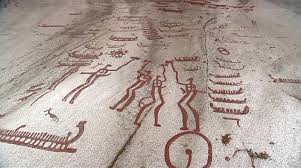
The Tanum Rock Carvings are hundreds of granite panels carved with petroglyphs, images pecked into the rock surface, spread across the landscape around Tanumshede in Bohuslän. They depict boats, humans, animals, weapons, footprints, and geometric symbols. The carvings are distributed across farms, fields, and outcrops in an area that was once shoreline, reflecting a maritime Bronze Age culture. UNESCO recognizes the ensemble as a single property titled “Rock Carvings in Tanum.”
The core area covers about 45 square kilometers and contains hundreds of carved panels with thousands of figures, representing one of Europe’s richest Bronze Age rock art landscapes (UNESCO listing).
How old are they and how were they made?
Most carvings date to the Nordic Bronze Age, roughly 1700 to 500 BCE, with some earlier and later additions. Dating is based on shoreline displacement, since post‑glacial land uplift moved former sea level terraces inland, and on stylistic sequences, especially the evolution of boat shapes. Researchers with the Swedish National Heritage Board and the Swedish Rock Art Research Archives have mapped panels and compared motifs to build relative chronologies (SHFA, RAÄ).
Artists pecked the images into glacially smoothed granite using hammerstones and pointed tools, probably of hard stone and later bronze or iron. This produced shallow, bright scars that were clearly visible when new. The red paint seen on some panels today is modern infill applied to improve visibility for visitors at selected sites, for example at Vitlycke, and it is documented and maintained by conservators (Vitlycke Museum).
What do the carvings depict?
The repertoire is broad and often narrative. Common motifs include:
- Boats, from small craft to long vessels with many crew marks, central to Bronze Age seafaring.
- Humans, including warriors with shields and axes, couples, dancers, and large figures like the “Spear God” at Litsleby, about 2.3 meters tall.
- Animals, such as bulls, deer, horses, birds, and fish.
- Weapons and tools, swords, axes, lures, plows, and wagons.
- Footprints and cup marks, small pecked hollows that may have ritual meanings.
- Geometric symbols, rings, wheels, and sun-like discs.
Scenes often suggest processions, combat, hunting, agriculture, and rituals. Some figures are explicitly sexual or phallic, which many scholars interpret in fertility or life-cycle contexts. While meanings are debated, most researchers agree the imagery encodes cosmology, social roles, and the importance of maritime connectivity in Bronze Age Scandinavia (Vitlycke Museum overview).
Why did UNESCO inscribe the Tanum rock carvings?
UNESCO cites Tanum as an exceptional artistic and cultural record of the European Bronze Age. The site shows long continuity, stylistic diversity, and a unique concentration of motifs tied to seafaring, agriculture, and ritual. It also preserves rock art in direct relation to the surrounding landscape, which helps reconstruct how people moved between sea and land.
UNESCO recognizes Tanum for its outstanding universal value as a testimony to the life and beliefs of Bronze Age peoples, and for the rich variety and high quality of its rock carvings across many centuries (UNESCO, Statement of Significance).
Where are the main panels and how can you visit?
The property includes many accessible sites near Tanumshede. A good starting point is the Vitlycke Museum, which provides maps, exhibitions, and guided walks. Four classic panels are signposted and have paths and information boards:
- Vitlycke, famous for the paired figures known as the “Bridal Couple” or “The Lovers,” plus large boats and rituals.
- Aspeberget, a hill with extensive carvings and wide views of the ancient shoreline.
- Litsleby, home to the towering spear-bearing figure and numerous boats and warriors.
- Fossum, a dense panel noted for layers of overlapping images.
Access is free year round, with parking at major stops. Low, raking light at sunrise or sunset, and damp rock after rain, makes carvings easiest to see. Stay on marked paths, never walk on the carvings, and avoid chalking or tracing. The County Administrative Board manages the site with a formal plan and local partners (County Administrative Board of Västra Götaland).
Visitors are asked not to touch or step on the figures, natural oils and abrasion accelerate weathering of the shallow pecked surfaces (Vitlycke Museum visitor guidance).
How are the carvings preserved and what threatens them?
Weathering, biological growth, freeze–thaw, and visitor wear are the main threats. Conservation teams monitor panels, clear vegetation, and, at selected sites, maintain reversible paint infill for visibility. Documentation projects by the Swedish Rock Art Research Archives create high resolution records, including 3D scans and calibrated photography, to track change and support research (SHFA).
Debate continues over visibility versus authenticity, since paint aids public understanding but can alter how the images are perceived. Management balances access with preservation, guided by UNESCO requirements and Swedish heritage law (UNESCO, RAÄ).