
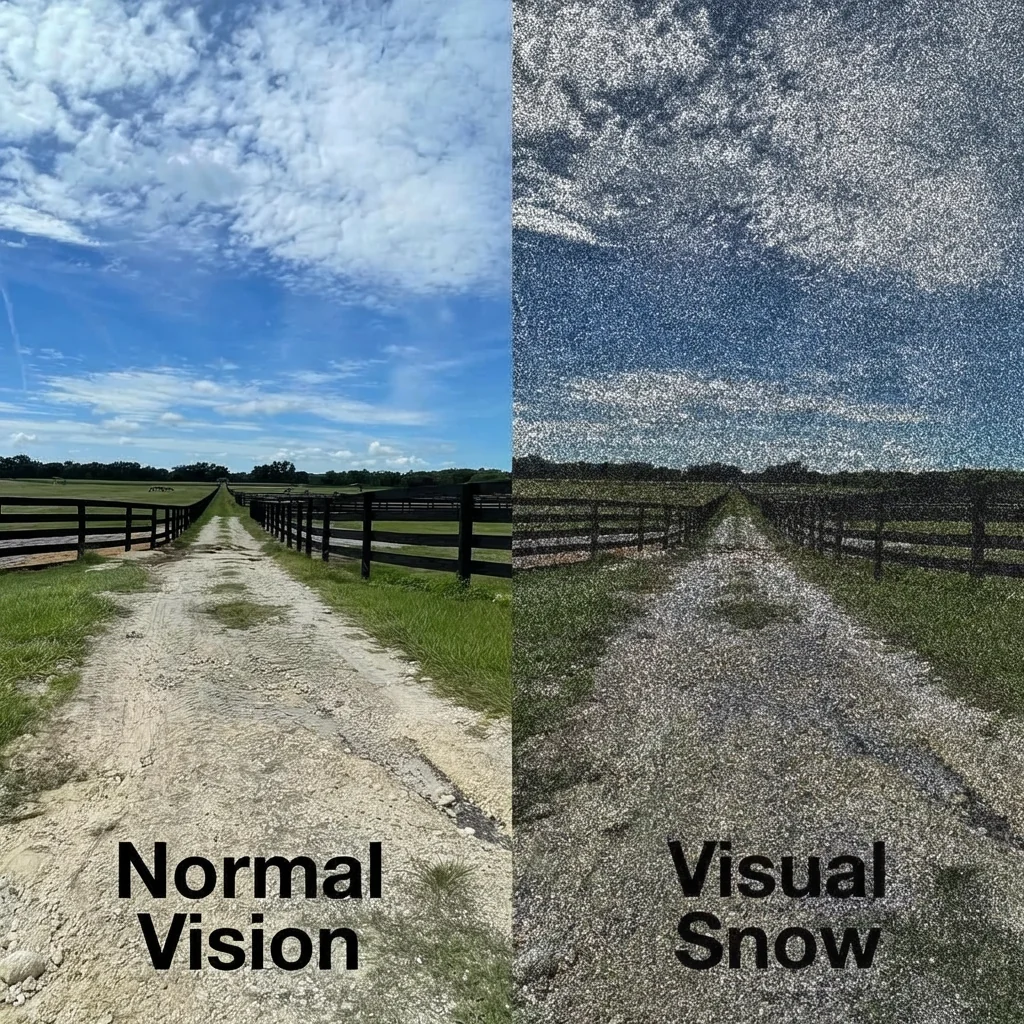
Visual snow syndrome is a neurological condition where people see a constant layer of tiny, flickering dots across their entire field of vision. It works by changes in how the brain processes visual information, not by a problem in the eyes themselves. Eye exams are usually normal, and the static is present in most lighting conditions, often worse in the dark.
What is visual snow syndrome?
Visual snow syndrome (VSS) is defined by continuous, dynamic “TV static” that overlays everything you see for at least three months, along with other visual disturbances. It is distinct from ordinary eye issues like refractive error or floaters. Clinicians consider it a disorder of visual processing in the brain rather than an eye disease, which is why routine ophthalmic tests are often normal (Cleveland Clinic), (American Academy of Ophthalmology).
Visual snow syndrome = persistent visual “static” plus additional visual symptoms, with normal eye exams and no other explanation.
How does visual snow syndrome work?
Evidence points to hyperexcitability and dysrhythmia in the visual cortex and related networks, which amplifies internal visual noise. In other words, the brain’s visual filters are set too “high gain,” so background neural activity becomes visible as grainy dots. This central mechanism explains why VSS is present with eyes open or closed and why it often coexists with migraine and tinnitus, which also involve sensory hypersensitivity (American Migraine Foundation), (Schankin et al., Brain).
What are the symptoms of visual snow?
The core symptom is a layer of fine, flickering dots across the whole visual field, typically in both eyes. Many people also report:
- Worse in low light, with night driving or dim rooms making the static more noticeable
- Photophobia (light sensitivity)
- Nyctalopia (poor night vision)
- Palinopsia (afterimages or trailing when objects move)
- Enhanced entoptic phenomena (seeing floaters, blue-sky “white blood cell” dots, starbursts)
- Tinnitus and migraine as common comorbidities
Symptoms range from mild and easily ignored to intrusive and anxiety provoking. Many people realize they have VSS only after learning that not everyone sees this static (Cleveland Clinic), (AMF).
How is visual snow different from normal visual effects?
Everyone experiences some visual noise in the dark or against featureless backgrounds because of the eye’s physics and the brain’s signal processing. That is normal. VSS is different in several ways:
- Persistent: present most of the time for months or years, not just occasionally
- Pan-field: across the entire visual field, not confined to one eye or one spot
- Context independent: noticeable in various lighting and scenarios, often worse but not limited to darkness
- Accompanied symptoms: palinopsia, photophobia, and other features listed above
Normal phenomena like the blue field entoptic effect, floaters, or dim-light grain are common. Visual snow syndrome persists beyond those and typically includes additional visual symptoms.
For a primer on normal entoptic effects, see the AAO’s overview (AAO).
Who gets visual snow, and what causes it?
VSS often starts in adolescence or early adulthood, but it can occur at any age. Many people report lifelong symptoms and only later recognize them as atypical. The exact cause is unknown. Proposed contributors include migraine biology, thalamocortical dysrhythmia, and sensory gating differences. VSS is distinct from hallucinogen persisting perception disorder (HPPD), although drug exposures can be part of the history and are considered in the evaluation (Schankin et al., Brain), (Practical Neurology).
How is visual snow diagnosed?
Diagnosis is clinical, based on history and exam, and by ruling out other causes. A typical eye exam and imaging are often normal. Consensus criteria include a minimum three-month history of dynamic visual static and at least two additional visual symptoms, with no better explanation such as retinal disease, optic neuropathy, medication effects, or HPPD (Schankin et al., Brain), (Cleveland Clinic).
If the static is new, in one eye only, or accompanied by a sudden curtain of darkness, flashing lights, severe headache, or neurological deficits, seek urgent medical care to rule out eye or brain emergencies.
Is there a treatment for visual snow syndrome?
There is no universally effective treatment yet, but several strategies may help:
- Tinted lenses (for example, precision tints or FL-41) can reduce glare and visual discomfort for some
- Migraine management and consistent sleep may reduce sensory hyperexcitability
- Vision therapy or neuro-optometric rehabilitation has anecdotal benefit in select cases
- Medications such as lamotrigine or topiramate have helped some patients in small series but can also worsen symptoms; decisions require specialist guidance
- Psychological support and education can reduce anxiety and improve coping
Because responses vary, work with a neurologist, neuro-ophthalmologist, or neuro-optometrist familiar with VSS to tailor options (AMF), (Cleveland Clinic).
What does this mean for day-to-day life?
Many people adapt and function well, especially when symptoms are mild. Problems often arise in low light, with night driving, or when anxiety increases attention to the static. Understanding that VSS is a recognized neurological condition, not “just your eyes,” can be reassuring and can guide you to the right specialists and accommodations.