
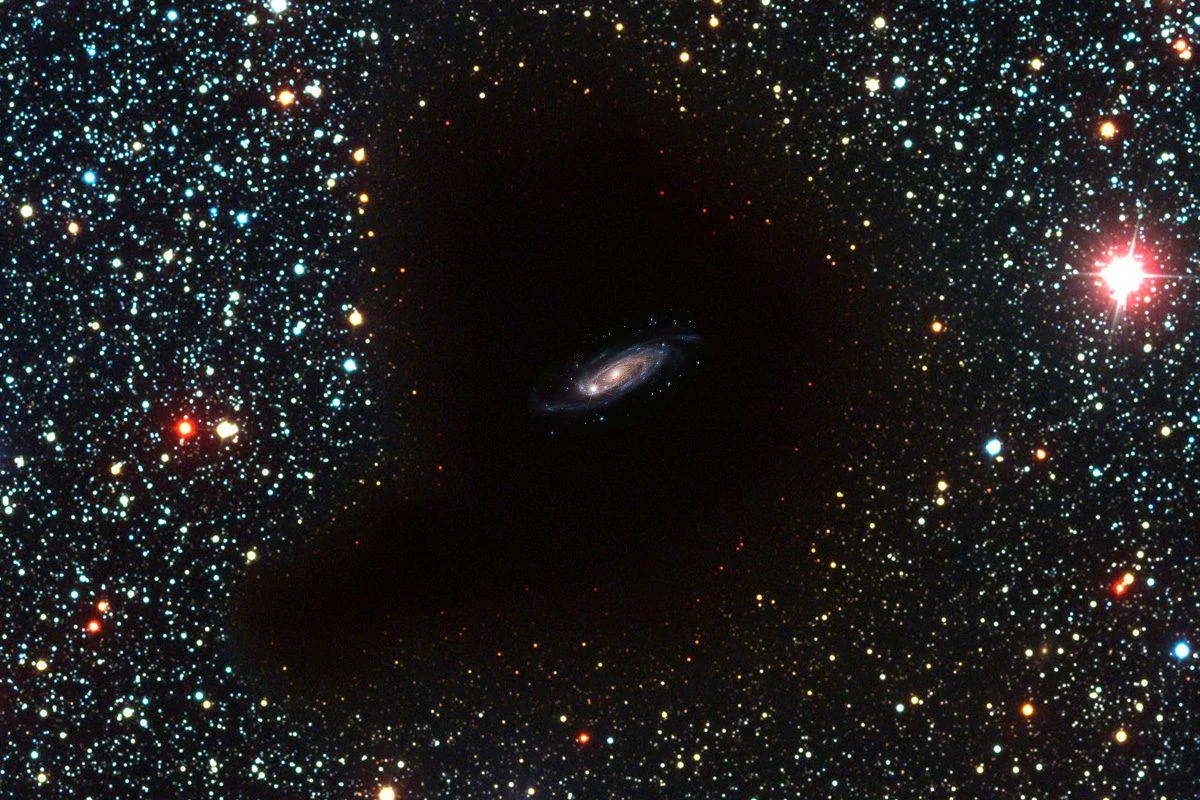
Probably not in the dramatic sense. Evidence suggests our region of the universe may be slightly underdense on very large scales, but not an enormous empty hole, and any such underdensity would change local Hubble constant measurements by only a small amount. It is unlikely to fully solve the Hubble tension, the mismatch between early universe and local expansion rate estimates.
What is a cosmic void?
A cosmic void is a large region of space with fewer galaxies than average. Voids are common features of the cosmic web, the vast network of galaxy clusters, filaments, and empty regions that formed from tiny density ripples in the early universe. Typical voids span tens to hundreds of millions of light years and are only modestly emptier than average, not truly empty.
Are we inside a cosmic void?
Several studies have explored whether the Milky Way sits in a mild local underdensity. Examples include the proposed “KBC void” and the “Local Hole,” based on galaxy counts and flow measurements that hint at slightly fewer nearby galaxies than expected over a few hundred million light years. See, for example, Keenan, Barger and Cowie’s analysis of a 300 megaparsec scale underdensity and Whitbourn and Shanks’ “Local Hole” galaxy counts (ApJ 2013, MNRAS 2014).
These features, if real, appear to be modest, not billion light year scale giant voids. Independent probes like the cosmic microwave background and galaxy surveys prefer a universe that is very close to homogeneous on the largest scales, and they strongly limit how big and how deep any local void could be without conflicting with other observations (Verde, Treu and Riess, Nature Astronomy 2019).
How could a local void affect the Hubble constant?
The Hubble constant (H0) measures how fast the universe expands per unit distance. If we live in a region that is less dense than average, gravity there is weaker, so the local expansion can be slightly faster. That could make nearby distance-ladder measurements of H0 come out higher than the global average, while early universe inferences from the cosmic microwave background favor a lower value.
The Hubble tension is the difference between local H0 measurements near 73 km/s/Mpc and early universe estimates near 67–68 km/s/Mpc (Riess et al., ApJ 2022; Planck Collaboration, A&A 2020).
In principle, a large, deep void centered on us could bias local measurements upward. In practice, placing us near the center of a huge void would violate the Copernican principle and is strongly constrained by multiple datasets.
Could a void solve the Hubble tension?
Current evidence says no. Detailed analyses that model local density variations and their impact on supernova distances find that any plausible local underdensity shifts H0 by a very small amount, not the 5 to 10 percent needed to erase the tension. For example, Kenworthy, Scolnic and Riess used Type Ia supernovae to show that local structure effects are too small to explain the discrepancy (ApJ 2019).
Quantitative studies find that realistic local voids would change H0 by less than about 1–2 percent, far short of the observed gap (Kenworthy et al., 2019; Verde et al., 2019).
Some new analyses continue to test whether a larger scale underdensity exists and whether it could contribute a small part of the discrepancy. But as of now, a local void is not a complete solution to the Hubble tension.
How is this different from the Local Bubble and from dark nebula images?
The Local Bubble is a cavity of hot, thin gas about 1,000 light years across inside the Milky Way, carved by past supernovae. It is a structure within our galaxy and has nothing to do with billion light year scale cosmic voids that affect H0 (Zucker et al., Nature 2022; overview at Wikipedia).
Popular images sometimes show a dark, round “hole” like Barnard 68, which is actually a small molecular cloud within our galaxy blocking background starlight, not an intergalactic void. It is about half a light year wide, not cosmological in scale (NASA APOD; Wikipedia).
What comes next?
Ongoing and upcoming surveys will map large scale structure and expand distance probes with much higher precision. Programs like DESI, Euclid and the Rubin Observatory will refine measurements of the matter distribution and cosmic expansion. Independent H0 methods, including strong lensing time delays and gravitational wave standard sirens, will help determine whether the tension points to new physics or to subtle systematics in one or more techniques (ESA Euclid).
Bottom line: we may live in a slightly underdense neighborhood, but it is not empty, it does not isolate us, and it likely cannot by itself resolve the Hubble tension.