
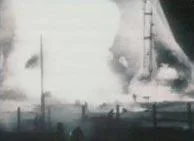
The Nedelin catastrophe was a 1960 launch pad explosion of an R‑16 intercontinental ballistic missile at the Soviet Baikonur test range. It occurred during ground tests when the second stage ignited unexpectedly, triggering a fireball that killed Marshal Mitrofan Nedelin and dozens of engineers and soldiers. The Soviet government suppressed the truth for nearly three decades, publicly acknowledging the disaster only in 1989.
What was the Nedelin catastrophe?
On 24 October 1960 at Baikonur, a prototype R‑16 missile designed by Mikhail Yangel’s bureau exploded on its pad during pre‑launch preparations. The accident, later called the Nedelin catastrophe after the head of the Strategic Rocket Forces who died on site, remains one of the deadliest incidents in the history of rocketry. Contemporary reconstructions and later disclosures agree that a premature engine start in a fueled vehicle led to rapid destruction of the rocket and a lethal fuel fire across the pad area [russianspaceweb], [Wikipedia].
Date and place: 24 October 1960, Baikonur test range. Vehicle: R‑16 ICBM. Fatalities: at least 54, with some estimates exceeding 100, including Marshal Mitrofan Nedelin [russianspaceweb], [Wikipedia].
How did the Nedelin catastrophe happen?
Investigations and later expert analyses point to a chain of procedural violations under schedule pressure. The missile was being readied for a milestone date, personnel bypassed safety interlocks and continued troubleshooting while the vehicle was fully fueled with hypergolic propellants, and temporary electrical shunts left the system vulnerable to an unintended ignition command.
- The R‑16 used a hypergolic pair, fuel and oxidizer that ignite on contact. The fuel was unsymmetrical dimethylhydrazine and the oxidizer was a nitric acid and nitrogen tetroxide mixture, both highly toxic and corrosive [Britannica], [russianspaceweb].
- With many leaders present on the pad, including Marshal Nedelin, technicians worked close to the vehicle to resolve last‑minute issues, contrary to basic range safety practice [russianspaceweb].
- When electrical systems were powered, the second stage engines started while the first stage remained attached and fully fueled. The resulting plume and tank rupture produced an immediate conflagration across the service towers and work stands [Wikipedia], [russianspaceweb].
Hypergolic propellants ignite spontaneously when fuel and oxidizer meet, which simplifies engine start but greatly increases risk during leaks or mishandling. This property made on‑pad troubleshooting with a fueled vehicle especially dangerous [Britannica].
How did the explosion unfold?
Witness accounts and later released footage indicate that the second stage ignition produced an intense fire that engulfed the lower stage and surrounding structures within seconds. Personnel on platforms and at the base of the pad had little time to evacuate. Many victims died instantly in the blast or from inhalation of toxic combustion products, and others succumbed to severe burns in the hours and days that followed [russianspaceweb], [Wikipedia].
How many people died and who were the victims?
The exact toll is uncertain because of the initial secrecy. Credible estimates range from at least 54 to more than 100 fatalities. A memorial list at Baikonur commemorates 78 names, while some later accounts suggest higher numbers. Among the dead were senior officers, engineers, and support personnel. Marshal Mitrofan Nedelin died at the site. Chief designer Mikhail Yangel survived because he had briefly stepped away from the pad shortly before the ignition [russianspaceweb], [Wikipedia], [Mitrofan Nedelin], [Mikhail Yangel].
Why was it kept secret and when was it revealed?
In 1960 the Soviet state treated major military and space failures as classified information. Families were told cover stories, often a plane crash, and public obituaries omitted the true cause of death. Details emerged only during the glasnost era. In 1989 Soviet media and officials acknowledged the accident, published names of victims, and released archival film and photographs from the site [Wikipedia]. Western observers and intelligence services had suspected a major incident at Baikonur soon after it occurred, based on indirect indicators, but authoritative public confirmation came from the USSR itself decades later.
What changed after the disaster?
The R‑16 program ultimately continued, and a redesigned vehicle reached operational status in 1962. The catastrophe drove major safety reforms across Soviet rocketry, including stricter pad clearance rules, remote operations during fueling and testing, enforcement of configuration control, and clearer authority to halt countdowns when safety conditions were not met [russianspaceweb].
- Pad operations with toxic hypergolic propellants adopted increased standoff distances and evacuation protocols.
- Electrical interlocks and test procedures were revised to prevent unintended ignition during integrated tests.
- The Strategic Rocket Forces instituted a day of mourning on 24 October, and Soviet organizations avoided conducting launches on that date after a separate 1963 pad accident also caused fatalities [Wikipedia].
The Nedelin catastrophe remains a case study in how schedule pressure, organizational culture, and hazardous propellants can combine to create extreme risk. Many modern range safety practices exist to prevent the exact chain of errors that unfolded at Baikonur.