
Yes. In a controlled 2020 study, African grey parrots voluntarily passed metal tokens to a partner so the partner could exchange them for food, even when the helper could not get a reward. The behavior meets the definition of prosocial helping and was not seen in a comparison macaw species in the same setup (Current Biology).
What is the African grey parrot helping study?
Researchers trained parrots to exchange metal rings for a walnut with a human experimenter. They then paired birds in adjacent chambers connected by a small transfer opening. In test trials, only one bird had tokens, while only the partner had access to the experimenter who would trade tokens for food. Any helping had to occur by voluntarily passing tokens through the opening so the partner could make the exchange (Brucks and von Bayern, 2020).
Prosocial behavior is helping another individual obtain a benefit, such as food, at no immediate gain to oneself.
How did the token-sharing experiment work?
The task alternated roles. In one condition, the helper had tokens but no access to the experimenter, while the partner had access to trade but no tokens. A small opening allowed token transfers. Control conditions ruled out simpler explanations: no-partner controls checked whether birds would pass tokens “into the void,” and blocked-window controls checked whether transfers happened only when help was actually possible. The researchers also tracked social relationships and whether past or future reciprocity was required to motivate helping.
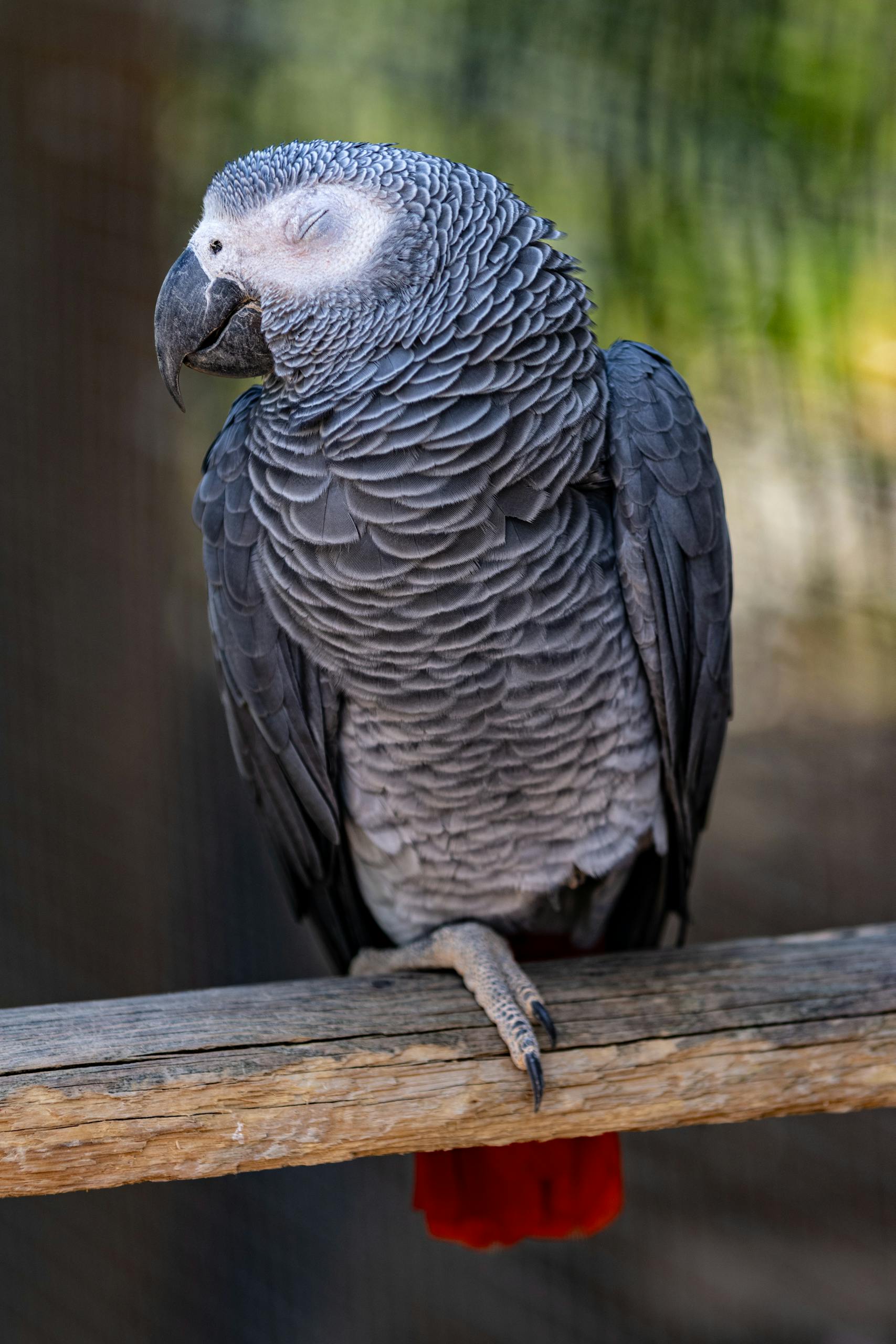
Crucially, the study compared species. African grey parrots (Psittacus erithacus) were tested alongside a macaw species under the same procedures. Only the greys consistently transferred tokens to enable a partner’s trade, indicating a species difference in this context-dependent helping (study details).
What did the researchers find?
African greys spontaneously passed tokens to partners who could exchange them for food, even when the helpers themselves could not earn a reward in that trial. They adjusted behavior to context, giving tokens only when a partner was present and able to trade, which argues against random passing or simple stimulus-driven behavior. The rate of helping did not require immediate payback, suggesting other-regarding preferences rather than direct quid pro quo.
In this setup, African greys helped partners obtain food without an immediate personal benefit, a result that the comparison macaw species did not reliably show (Current Biology).
Social dynamics mattered. Requests from partners and relationship quality influenced transfers, consistent with findings in other social animals. Yet the core effect remained, helping without a direct payoff, across birds and sessions. A summary from the Max Planck Society provides an accessible overview of the protocol and results (Max Planck Society).
Does this mean African grey parrots are altruistic?
It demonstrates prosocial helping, which is a component of altruism. Strict biological altruism usually implies a cost to the helper, not just lack of immediate benefit. In many trials, helpers surrendered tokens they could have used in other contexts, which is a real opportunity cost, but the lab design keeps costs modest. The safest conclusion is that African greys show other-regarding preferences and flexible helping in a social task, not that they possess human-like moral altruism.
How does this compare with chimpanzees and other animals?
Prosociality varies by species, task, and social context. Some classic experiments found that chimpanzees often act indifferently to a partner’s payoff when there is no personal gain (Silk et al., Nature 2005). Other work shows chimpanzees make prosocial choices when tasks fit their natural tendencies, such as releasing food to a groupmate (Horner et al., PNAS 2011). Corvids and parrots, both with large brains and complex social lives, have repeatedly shown advanced problem solving and flexible cooperation in lab tasks. The grey parrot study adds to this body of evidence by meeting a strong criterion, helping another obtain food without a direct reward.
What are the limitations of the parrot study?
- Sample sizes are modest, as is common in animal cognition research.
- Token exchange is a trained, artificial task, so results speak to general capacities under controlled conditions, not wild foraging behavior.
- Helping can be influenced by partner signals and relationships, which can be hard to standardize across pairs.
- Species differences were observed in this task, so findings should not be generalized to all parrots without further testing.
Even with these caveats, the converging controls and cross-species comparison make the main conclusion robust for the conditions tested.