
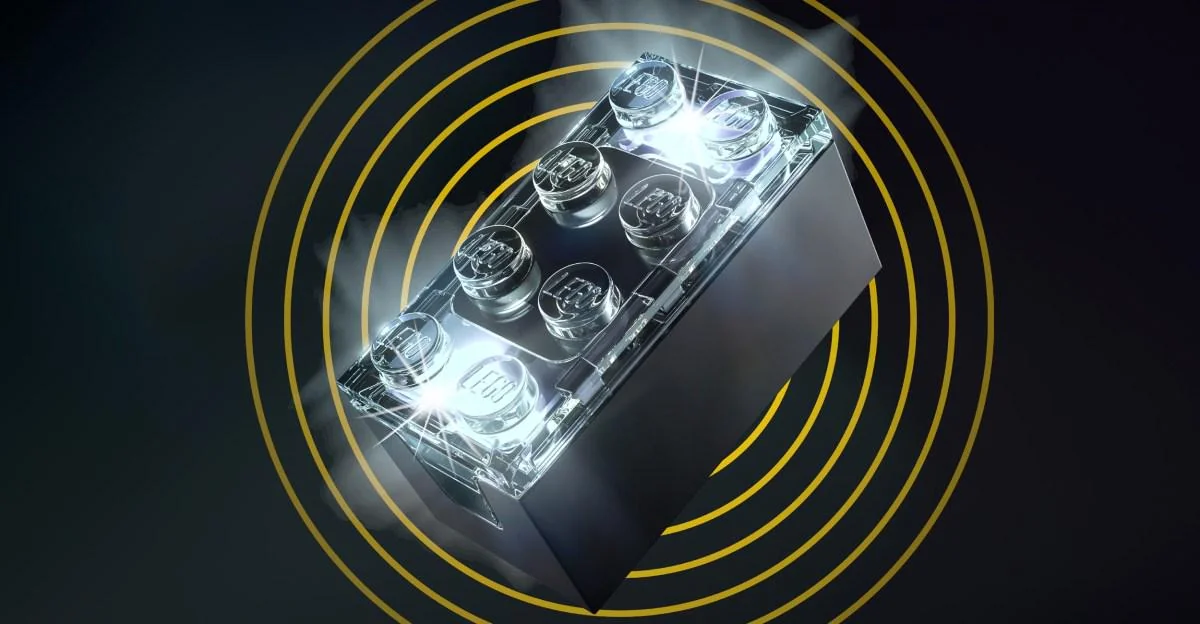
Lego Smart Brick is a connected Lego brick with built-in sensors, speaker, and lights that make models react to movement, light, and nearby smart pieces. It works by creating a Bluetooth mesh with other Smart Bricks and tagged components, so builds can recognize position, orientation, gestures, and specific characters or props. Early sets use the brick to trigger effects like sounds and music when figures or tagged elements are placed or moved, according to The Verge’s report.
What is Lego Smart Brick?
Lego Smart Brick is an electronic brick designed to integrate seamlessly into standard Lego builds and enable interactive play. Launch details highlighted by The Verge describe a brick that adds sound, light, and sensing to models, and recognizes other connected pieces, including special smart minifigures and “tags” attached to vehicles or scenery.
Smart Brick adds onboard light and sound, light and inertial sensors, and connects over Bluetooth in a mesh so builds can react to movement, tilt, gestures, and nearby smart components.
How does the Lego Smart Brick work?
The system combines onboard hardware with short-range wireless networking to coordinate multiple pieces in a build.
- Sensors: Light sensor, inertial sensors for movement, tilt, and gesture detection, as summarized by The Verge.
- Outputs: Integrated lights and a speaker for sound effects and music.
- Bluetooth mesh: Smart Bricks and compatible parts form a mesh network, which lets them be aware of each other’s presence, position, and orientation. This enables interactions across a model without a single central hub.
- Smart tags and figures: Tagged elements and special minifigures can be recognized to trigger context-specific effects, for example a character theme playing when placed on a certain build element.
Lego says the bricks form a Bluetooth mesh and are aware of one another’s position and orientation, enabling coordinated reactions across a model (The Verge).
In practice, that means a starfighter, a turret, and a character can “know” where they are relative to each other and react accordingly, such as initiating a battle sequence or playing a theme when a figure sits on a throne, as described in the coverage.
What Lego sets include Smart Bricks and what do they cost?
The initial wave, reported at CES, includes licensed Star Wars sets that bundle Smart Bricks, smart tags, and smart minifigures. The Verge lists the following assortments:
- Darth Vader’s TIE Fighter, 473 pieces, about $70, includes one Smart Brick, one TIE Fighter smart tag, and one Darth Vader smart figure.
- Luke’s Red Five X-Wing, 584 pieces, about $100, includes one Smart Brick, five tags (X-Wing, Imperial turret, transporter, command center, and R2-D2 accessories), plus Luke and Leia smart figures.
- Darth Vader’s Throne Room Duel & A-Wing, 962 pieces, about $160, includes two Smart Bricks, three smart figures (Luke, Emperor Palpatine, Vader), and five tags (A-Wing, throne, Death Star turret, and two lightsabers).
These sets showcase how the system coordinates multiple tagged elements and characters for scenario-based play.
Does Lego Smart Brick use AI or require programming?
No. Reporting on the announcement states there is no AI involved. The interactions are driven by the brick’s sensors and the Bluetooth mesh awareness of other smart components, not by machine learning or cloud AI. There is no indication of required coding for core features in these launch sets. The Smart Brick approach differs from discontinued STEM lines like Mindstorms and Boost, which emphasized user programming.
“They specifically said that there is no AI involved,” summarized in user discussions of The Verge report.
What are the benefits and limitations?
Benefits
- Immediate, build-integrated interactivity without custom wiring or external hubs.
- Coordinated reactions across multiple elements through Bluetooth mesh.
- Context-aware play, for example character themes or battle responses tied to position or orientation.
Limitations and open questions
- Openness and longevity: Past connected lines like Mindstorms and Boost were discontinued, which concerns some buyers about long-term support. Lego has not detailed long-term software support for Smart Brick.
- Power and maintenance: Battery type and life, charging method, and replacement processes were not specified in the cited report.
- Customization: The launch focus is on set-driven interactions. There is no confirmation of a programming interface for user-defined behaviors.
- Privacy and connectivity: The system uses local Bluetooth mesh. There is no information about accounts, apps, or cloud connectivity in the initial coverage, and no mention of subscriptions.
What does this mean for Lego builders?
Smart Brick shifts interactivity from app-led or motor-only builds to brick-level sensing and local coordination. For play-focused sets, it enables simple, responsive effects that are tied to how and where you place pieces. For hobbyists who valued Mindstorms-like programmability, Smart Brick is not a direct replacement, at least at launch. Its value will depend on how widely Lego integrates the standard across themes, whether an open or semi-open API appears, and how well the company supports the platform over time.
If you want interactive sets that react out of the box without coding or cloud services, Smart Brick is designed to do exactly that. If you are looking for a programmable robotics platform, this is not that, based on the information available so far.