
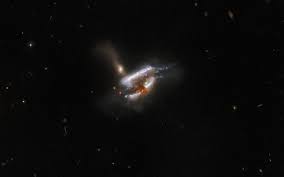
A triple-galaxy merger is when three galaxies are colliding and will eventually combine into one larger galaxy. It happens through gravity, as tidal forces and dynamical friction drain orbital energy, funnel gas inward, and pull the galaxies and their central supermassive black holes together over hundreds of millions of years. In rare cases, all three black holes are active at once, producing radio jets that reveal a triple active galactic nucleus.
What is a triple-galaxy merger?
A triple-galaxy merger is a gravitational interaction involving three galaxies that are close enough to be bound and on intersecting orbits. Instead of a simple pairwise encounter, three bodies exchange energy and angular momentum, leading to a complex sequence of close passes and tidal distortions before the system coalesces into a single remnant galaxy.
Triple mergers are uncommon compared to two-galaxy mergers, partly because the timing must align. When they occur, they can briefly light up as triple AGN if each galaxy’s central black hole is actively accreting gas. Systems with three simultaneously active nuclei have been observed, though they are rare and often heavily obscured by dust, for example the Chandra-identified triple system reported by Pfeifle and colleagues in 2019 (Chandra press release).
Active galactic nucleus (AGN): the bright, compact region at a galaxy’s center powered by gas falling onto a supermassive black hole, which can launch high-energy radiation and sometimes collimated radio jets (NASA GSFC).
How does a triple-galaxy merger work?
The physics is the same as for any merger, but with three interacting galaxies the choreography is more chaotic and efficient at redistributing energy. The broad sequence looks like this:
- First approaches: Gravitational tides stretch spiral arms into tails and bridges, and dynamical friction slows the galaxies.
- Gas inflows and starbursts: Tidal torques drive cold gas toward the centers, triggering intense star formation and feeding central black holes.
- Multiple close passages: With three bodies, near-misses and swaps of orbital energy are common, which can speed up the final coalescence compared to a simple pair.
- Final coalescence: Stellar orbits randomize, gas settles, and the system relaxes into a single, more massive galaxy that often looks elliptical.
Radio telescopes such as the Karl G. Jansky Very Large Array can reveal jets and compact radio cores from each active nucleus, even when dust hides the centers at optical wavelengths (NRAO VLA).
What happens to the supermassive black holes and AGN?
Each merging galaxy brings in a central supermassive black hole. As the galactic centers sink toward one another, the black holes form a bound pair, and in a triple encounter a third black hole can join the dance. Gas funneled inward can ignite AGN activity in one, two, or all three nuclei, sometimes producing radio-bright jets.
- Activation: Inflows of gas and dust temporarily increase accretion, turning quiescent black holes into luminous AGN.
- Three-body effects: A third black hole can accelerate the merger of a pre-existing pair by extracting angular momentum, or it can slingshot one black hole outward through gravitational interactions. These processes help overcome the so-called “final parsec” barrier discussed in black hole binary evolution studies.
- Gravitational waves: When black holes finally coalesce, they emit low-frequency gravitational waves. A background of such waves, likely from many supermassive black hole binaries in merging galaxies, has been reported by pulsar timing arrays such as NANOGrav (NANOGrav 15-year results), and future space missions aim to detect individual mergers.
Key implication: Triple mergers provide natural pathways to create and harden supermassive black hole binaries, a prime target for the planned Laser Interferometer Space Antenna, LISA (LISA mission).
What happens to stars and planetary systems during a merger?
Despite dramatic images, stars are so far apart that direct star–star collisions are extremely unlikely. Most stars pass by each other, and while galactic orbits are rearranged, a typical planetary system remains gravitationally bound to its host star.
During galaxy collisions, the chance of two stars hitting each other is vanishingly small because their sizes are tiny compared to their separations (Hubble press release on the Milky Way–Andromeda merger).
There can be indirect effects. Gas clouds can be compressed, fueling new star formation, and tidal forces can perturb outer comet reservoirs. The best-studied example is our future two-galaxy collision: the Milky Way and Andromeda will likely merge in about 4 to 5 billion years, with simulations indicating little risk to the Solar System from direct stellar encounters (Hubble, updated with ESA Gaia measurements).
Why is a triple-galaxy merger important?
Triple mergers are natural laboratories for several frontier questions in astrophysics:
- Galaxy growth: They rapidly build massive galaxies and can transform spirals into ellipticals.
- Black hole coevolution: Coordinated AGN activity traces how black holes and their host galaxies grow together.
- Feedback and jets: Multiple AGN can inject energy into gas through radiation and radio jets, affecting star formation across the system.
- Gravitational waves: They seed the supermassive black hole binaries that underpin the low-frequency gravitational wave sky.
Recent observations confirming systems with three active, radio-bright nuclei have moved triple radio AGN from theory into reality, giving astronomers a new window into the life cycle of supermassive black holes (Chandra example, NRAO VLA capabilities).
What are the observational challenges and what comes next?
Identifying triple mergers is hard. The nuclei are crowded, dust can obscure the centers, and the times when all three black holes are active are short. Astronomers use multiwavelength observations to build the case: high-resolution radio for jets, X-rays for accretion signatures, infrared for dust-embedded nuclei, and optical spectroscopy for galaxy dynamics.
Next-generation facilities will expand the sample. Wide radio surveys and higher-resolution arrays will find more radio-bright nuclei, infrared telescopes will penetrate dust, and X-ray observatories will separate multiple accreting sources. On longer timescales, LISA aims to detect individual supermassive black hole mergers, linking what we see in light to what we hear in gravitational waves (LISA).