
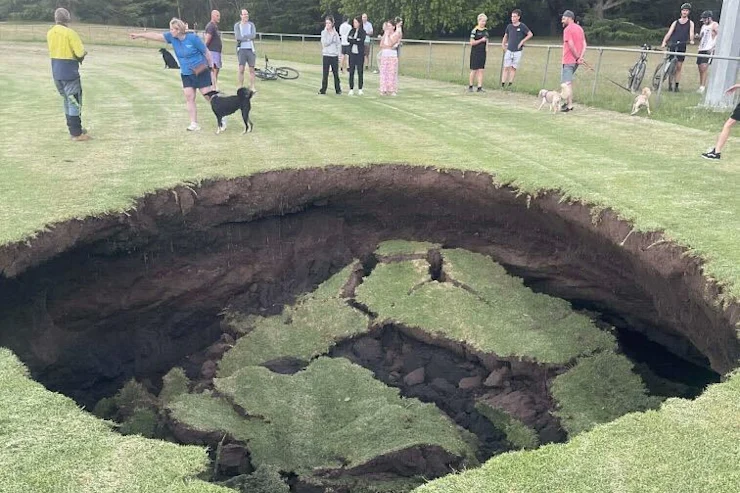
Yes, tunnelling can cause sinkholes when soil is lost from above or ahead of a tunnel and a void migrates upward to the surface. These collapses can be hazardous to people, utilities and buildings, although large projects use monitoring and rapid ground treatment to reduce risk. In Melbourne’s Heidelberg, tunnelling on the North East Link has been paused while investigators examine a several metre wide hole on AJ Burkitt Oval that authorities say the nearby tunnel boring machines may have contributed to (The Age).
What is a sinkhole?
A sinkhole is a sudden ground collapse that creates a surface crater. Many natural sinkholes occur in karst terrain, where water dissolves limestone and creates underground voids. Sinkholes can also be human induced, for example from leaking water mains, poor compaction, or underground excavation such as tunnelling.
The USGS notes that human activities, including drilling and excavation, can trigger sinkholes even outside classic karst geology (USGS).
Can tunnelling cause sinkholes?
Yes. In soft ground, tunnelling can lead to local settlement or a sudden crater if ground is inadequately supported and moves into the excavation. This is sometimes called ground loss or a chimney collapse when a void forms above the tunnel and works its way to the surface.
In Heidelberg, the North East Link team confirmed the tunnel boring machines were close to the pit and said they were a contributing factor under investigation. The machines have operated about 20 metres below the surface and tunnelling has been paused while the area is secured (The Age). Local news footage shows the fenced exclusion zone and ongoing assessments (7NEWS).
How do construction induced sinkholes form during tunnelling?
Modern tunnel boring machines, such as earth pressure balance and slurry TBMs, are designed to keep the ground stable by balancing soil and water pressures at the cutting face. A surface crater can still occur if conditions exceed the control envelope or if ground support is compromised. Typical mechanisms include:
- Face instability, where soil at the tunnel face collapses into the machine if support pressure is too low or the geology is weaker than expected.
- Over excavation or voids around the lining, for example due to inadequate tail seal grout, leading to ground migrating into annular gaps.
- Inflow of water and soil through permeable layers or unexpected openings, which can carry material into the tunnel and leave a void above.
- Existing ground defects such as old services, backfilled basements, or variable layers that allow a vertical chimney to form.
The FHWA tunnel design manual describes these mechanisms and their control through face pressure management, preconditioning and grouting, and settlement monitoring (FHWA Tunnel Technical Manual).
Are tunnelling related sinkholes dangerous?
Any sudden surface collapse is a safety hazard. People, vehicles, and animals near the rim can be injured if the edge continues to unravel. Utilities such as water or gas lines and nearby structures can also be affected by local settlement. Most project teams respond by establishing a wide exclusion zone, pausing tunnelling, and stabilising the ground from the surface and within the tunnel.
In Heidelberg, authorities reported no injuries, fenced off the oval, and paused tunnelling to investigate and make the site safe (The Age).
How do engineers prevent and fix sinkholes during tunnelling?
Large urban projects plan for settlement control from the start. Common prevention and mitigation tools include:
- Ground investigation and modelling to map soils and groundwater, and to anticipate weak layers or high pressure zones.
- Pressurised TBM operation with continuous face pressure control, soil conditioning, and careful excavation volume control.
- Annulus grouting behind tunnel linings to fill the gap as segments are installed.
- Probe drilling and pre grouting ahead of the face where voids or inflows are suspected.
- Compensation grouting, injecting grout from shafts to counteract settlement and stabilise soil during passage under sensitive assets.
- Monitoring, including survey points, extensometers, piezometers and real time TBM telemetry, so crews can adjust operations promptly.
If a crater forms, crews typically stabilise the rim, fill the void with low mobility grout or controlled fill, and seal pathways of ground loss from underground. Compensation grouting can be used to lift or support affected ground and structures, a technique refined on projects such as Crossrail in London (Crossrail Learning Legacy).
What should residents do if they live near tunnelling?
- Respect any fencing and exclusion zones, and keep children and pets away from the edge of any depression.
- Report new, unexplained ground depressions or rapidly worsening building cracks to the project’s community contact and local council. Call emergency services if there is immediate danger.
- Document conditions with photos and dates. Projects usually maintain monitoring programs and claims processes for property impacts.
- Follow official updates from the delivery authority, for example the North East Link Project’s works notices and traffic updates (North East Link Project).
What does this mean for Melbourne’s North East Link?
The Heidelberg surface hole will be investigated to determine the precise cause and the best remediation plan. Tunnelling has been paused, which may affect schedules until ground is stabilised and monitoring shows conditions are controlled. Authorities have said there is no immediate threat to nearby homes, and they are prioritising surface and underground safety while the investigation proceeds (The Age).
Events like this are uncommon relative to the scale of modern tunnelling, but they are a known risk in soft ground and are managed through conservative operations, continuous monitoring, and rapid response. Residents can expect ongoing inspections and communications as works resume once the ground is made safe.