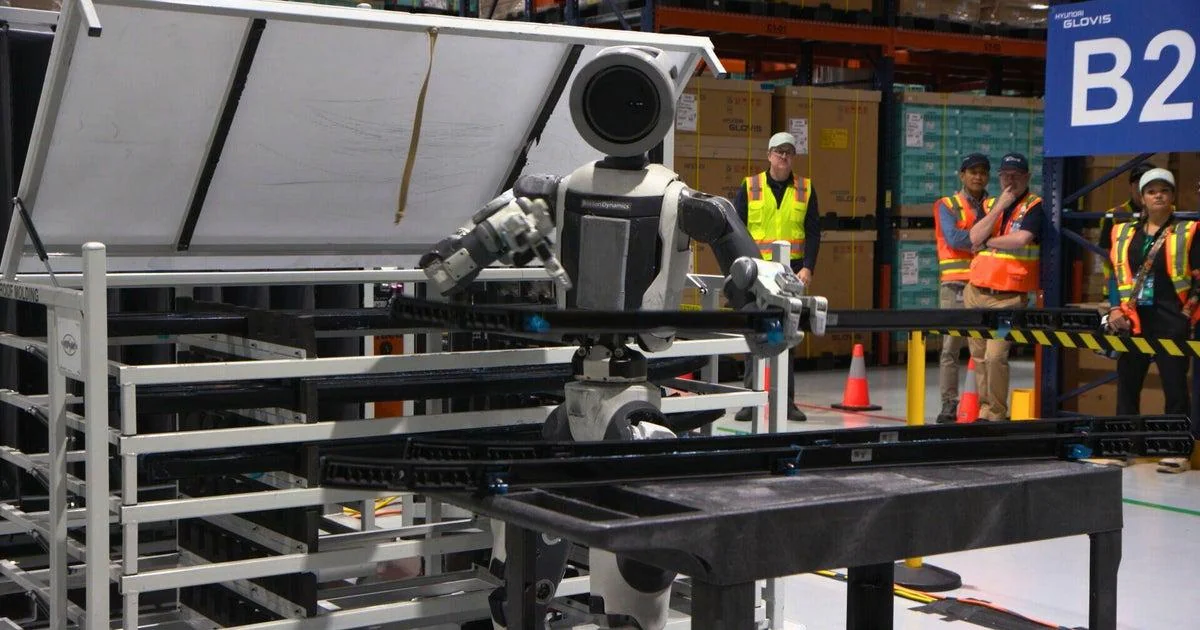
Atlas is a 5 foot 9 inch, 200 pound AI powered humanoid robot built by Boston Dynamics to do physical work in human environments. It works by combining onboard perception and control with machine learning models trained from human demonstrations and large scale simulation, enabling the robot to plan and execute tasks autonomously. The latest all electric Atlas runs its AI models on Nvidia processors and has begun real world testing on factory tasks at Hyundai’s new plant in Georgia, according to CBS 60 Minutes.
Atlas is a 5 foot 9 inch, 200 pound, AI powered humanoid created by Boston Dynamics, now testing autonomous warehouse tasks at a Hyundai factory.
What is Atlas?
Atlas is Boston Dynamics’ flagship humanoid designed for complex, human scale manipulation and mobility. Earlier versions were hydraulic and focused on agility demonstrations. The new generation is all electric, uses a suite of cameras and sensors for perception, and executes learned policies that let it navigate and manipulate objects without step by step programming. Boston Dynamics says the goal is a productive, general purpose worker for industrial settings, not a research demo (CBS).
How does Atlas learn to do tasks?
Boston Dynamics shifted from hand written algorithms to machine learning, where the robot acquires skills from data and practice. The company described three complementary methods on 60 Minutes:
- Teleoperated demonstrations: An expert wearing a VR headset directly controls Atlas to perform a task multiple times. Those trajectories become supervised training data that teach Atlas to repeat the task autonomously later.
- Imitation from motion capture: Human movements captured by a mocap suit are retargeted to Atlas’ different body, providing additional examples for training policies that map perception to action.
- Massive simulation: Thousands of virtual Atlases practice in parallel for hours with varied conditions like slippery floors or inclines. The best performing policies are distilled and uploaded to the physical robots, so once one learns, all can perform the skill.
These learned policies run on Nvidia chips that process sensor input and coordinate whole body motion in real time. The result is an autonomous system that can perceive its surroundings, generalize across modest changes, and carry out tasks such as sorting and handling factory parts without minute by minute human guidance (CBS).
What did Atlas do at Hyundai’s factory?
In its first field test outside the lab performing real work, Atlas practiced autonomously identifying and sorting roof rack parts in a warehouse at Hyundai’s new plant near Savannah, Georgia. The site already deploys more than 1,000 industrial robots alongside about 1,500 humans. Boston Dynamics’ team brought Atlas to evaluate how its learned skills transfer from simulation and lab setups to a production environment and to gather data for refinement (CBS).
The company’s leadership expects it will be several years before Atlas could join a factory workforce full time, reflecting the need for reliability, safety validation, and the breadth of skills required for sustained operations.
What are the limitations and safety considerations?
Despite rapid progress, Atlas and other humanoids remain far from human level capability in unstructured tasks. Boston Dynamics researchers note that many everyday activities, such as dressing, pouring liquids, or carrying items across cluttered spaces, are still beyond current systems’ robustness. Training often reveals failure modes, which the team treats as opportunities to improve models and hardware (CBS).
- Humanoids still struggle with dexterous, contact rich manipulation and long horizon tasks.
- They require careful safety engineering and human oversight during development and deployment.
- The robots are not sentient, and autonomy remains task scoped, with continuous monitoring and updates.
Boston Dynamics emphasizes using robots for jobs that are repetitive, back breaking, or hazardous, where machines can tolerate heat, heavy loads, or dangerous environments better than people.
What does this mean for jobs and the robotics industry?
Atlas is a marker of a broader race to build general purpose industrial humanoids, with competitors ranging from Tesla to startups backed by Amazon and Nvidia, as well as state supported efforts in China. Boston Dynamics’ CEO says repetitive tasks will shift to robots over time, while human roles grow in building, training, and servicing these systems. The company’s four legged Spot already performs inspections at factories, including Hyundai, illustrating a path from specialized robots to more general humanoid workers (CBS).
Goldman Sachs expects the humanoid market to reach about 38 billion dollars within the decade, highlighting the commercial stakes of today’s field trials.
Timeframes are uncertain, but the Hyundai deployment signals that humanoids are moving from staged demos to pilot work cells, with AI driven training pipelines and compute enabling faster iteration than in past robotics cycles.