
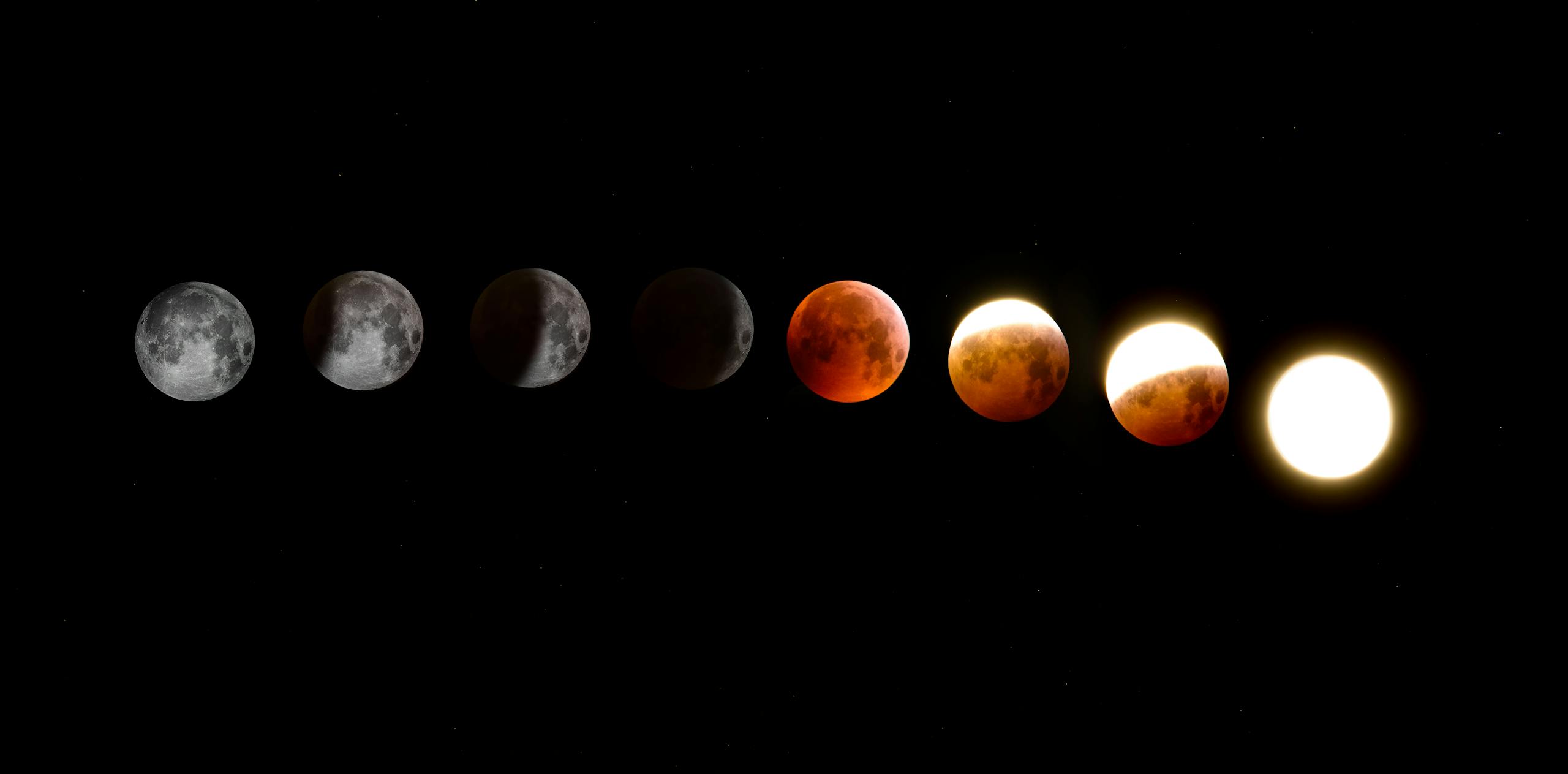
A blood moon is a total lunar eclipse, the moment when the Moon moves entirely into Earth’s darkest shadow and appears red. It happens because sunlight is filtered and bent through Earth’s atmosphere, which removes much of the blue light and lets mostly red light reach the Moon. The Moon then reflects that reddish light back to us, so it looks copper to brick red from Earth.
What is a blood moon?
A “blood moon” is a popular nickname for a total lunar eclipse. During a total lunar eclipse, the Moon is fully inside Earth’s umbra, the central, dark part of our planet’s shadow. The term does not imply any special meaning beyond the eclipse itself, and it is a purely astronomical event that aligns the Sun, Earth, and Moon.
A blood moon is simply a total lunar eclipse viewed from Earth, not a separate kind of Moon or a sign of unusual events.
NASA explains lunar eclipses and the red color on its overview of lunar eclipses and its guide to why the Moon turns red.
How does a blood moon work?
When the Moon passes into Earth’s umbra, it would look black if no light reached it. But Earth’s atmosphere acts like a lens, bending sunlight into the shadow. Along the way, air molecules and tiny particles scatter shorter, bluer wavelengths more than longer, redder wavelengths. This process, called Rayleigh scattering, leaves the refracted light that reaches the Moon dominated by reds and oranges, the same reason sunrises and sunsets look red.
From the Moon’s surface, the edge of Earth would look like a ring of red sunrises and sunsets. That ring lights the lunar surface during totality, giving it the “blood” color we see from Earth. NASA’s science pages illustrate this mechanism clearly (lunar eclipses).
Does a blood moon have any impact on Earth or people?
Scientifically, there are no special physical effects from a blood moon beyond a normal full Moon. It is completely safe to look at with your eyes or binoculars.
Unlike a solar eclipse, a lunar eclipse is safe to view without filters, with the naked eye, binoculars, or a telescope.
Gravitational effects are the same as any full Moon, which already coincides with spring tides when Sun and Moon pull in line. There is no credible evidence that lunar eclipses increase earthquakes or cause health effects; the USGS notes no established link between lunar phases and damaging earthquakes (USGS).
The main “impact” is simply a temporary dimming of the night as the bright full Moon turns dark red, which many people enjoy observing and photographing.
How long does a blood moon last and how often does it happen?
The entire eclipse, including partial and penumbral phases, can last several hours. The totality phase, when the Moon is fully red, typically lasts 30 to 90 minutes. The theoretical maximum is about 1 hour 47 minutes, achieved when the Moon passes near the center of Earth’s shadow and is near apogee (its farthest point from Earth, so it moves a bit more slowly against the sky). A well known long totality occurred on 27 July 2018, which lasted about 1 hour 43 minutes.
Totality can last up to roughly 1 hour 47 minutes, while the full event spans several hours from first to last contact.
Lunar eclipses occur a few times per year globally, but any given location will only see some of them and not all will be total. You can check exact visibility and local times for your location on timeanddate.com’s eclipse portal.
Why do some blood moons look darker or brighter?
The brightness and color depend on the state of Earth’s atmosphere. If the atmosphere is clear, more red light reaches the Moon and the eclipse looks bright copper. If there are many aerosols from pollution or volcanic eruptions, the atmosphere absorbs and scatters more light, making the eclipse darker, sometimes brownish or even nearly gray. Astronomers often describe this using the Danjon scale of eclipse brightness (explanation).
Satellite observations have shown that major volcanic eruptions can noticeably darken subsequent lunar eclipses by loading the stratosphere with light-blocking particles (see NASA Earth Observatory discussions of volcanic aerosols).
How to see a blood moon
- No special equipment is required, but binoculars or a small telescope enhance the view.
- Find a spot with a clear, low horizon and minimal light pollution.
- Check your local timetable for each phase, from penumbral start to totality, via timeanddate.com or NASA’s eclipse pages.
- Photography tip: use a tripod, manual focus, and a moderate telephoto lens, adjusting exposure as the Moon darkens.