
No. Modern humans (Homo sapiens) were not in the Philippines 709,000 years ago. Evidence from the Kalinga site on Luzon shows that hominins, likely a premodern human species, butchered a rhinoceros there about 709,000 years ago using simple stone tools, but the species is unknown and was almost certainly not Homo sapiens (Ingicco et al., Nature 2018). Homo sapiens did not evolve until roughly 300,000 years ago (Hublin et al., Nature 2017).
What is the evidence at the Kalinga site in Luzon?
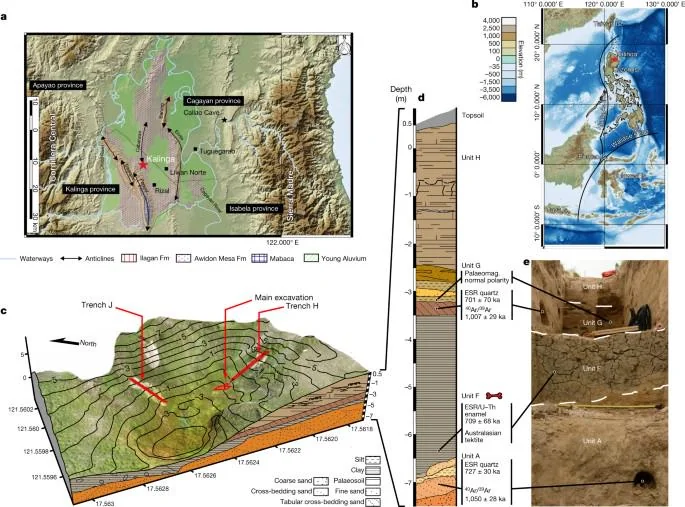
Archaeologists uncovered a partially butchered Rhinoceros philippinensis skeleton associated with 57 knapped stone artifacts in Kalinga, northern Luzon. The bones preserve clear cut marks from stone tools and percussion damage from marrow extraction, a pattern that matches hominin butchery rather than carnivore activity or natural breakage (Nature 2018). The tools are simple flakes, cores, and hammerstones made from local raw materials, consistent with Lower to Middle Pleistocene technology.
Key finding: A butchered rhinoceros and stone tools in Kalinga demonstrate hominin activity in the Philippines about 709,000 years ago, making it one of the oldest known hominin sites in Southeast Asia.
Were these modern humans or another hominin?
The Kalinga discovery documents activity, not hominin fossils, so the exact species is unknown. Researchers describe the toolmakers as premodern hominins, which could include Homo erectus-like populations known elsewhere in Pleistocene Asia. It was not Homo sapiens, which appears hundreds of thousands of years later (Nature 2017). Much later, a distinct species, Homo luzonensis, is documented in northern Luzon from about 50,000 to 67,000 years ago in Callao Cave (Détroit et al., Nature 2019), but whether it descends from the much earlier Kalinga population is unknown.
Definition: Hominins are members of the human lineage after the split from chimpanzees, including modern humans and extinct species such as Homo erectus, Neanderthals, and others.
How old is Kalinga and how was it dated?
Scientists dated the site by applying electron spin resonance with uranium-series (ESR/U-series) methods to the rhinoceros tooth enamel and associated sediments. The resulting age is 709,000 ± 68,000 years, placing the butchery in the Middle Pleistocene (Nature 2018). This multi-method approach is standard for sites of this antiquity and is consistent with the level of toolmaking observed.
Kalinga dates to about 709,000 years ago based on ESR/U-series analysis of the rhinoceros remains and site sediments (Nature 2018).
How could hominins reach Luzon without land bridges?
During ice-age low sea levels, parts of Southeast Asia formed the larger landmass of Sundaland, but the deep channels around much of the Philippines prevented a full land bridge to Luzon. This means early hominins likely crossed water, whether accidentally on storm-tossed vegetation rafts or intentionally using simple rafts, as also inferred for early hominins on Flores in Indonesia by about 700,000 to 1,000,000 years ago (van den Bergh et al., Nature 2016). Paleogeographic reconstructions show repeated sea-level changes, yet persistent deep-water gaps around Luzon (Voris, J. Biogeography 2000).
- No continuous land bridge to Luzon during the Pleistocene, due to deep marine trenches and straits.
- Possible “stepping-stone” routes via islands such as Palawan, with short but real sea crossings.
- Crossings could have been accidental drift or simple watercraft, not necessarily complex boats.
Why does this discovery matter?
Kalinga pushes hominin presence in the Philippines back by more than half a million years, showing that early human relatives reached oceanic islands far earlier than once assumed. It contributes to a broader pattern across Island Southeast Asia that includes early occupation of Flores and later unique island species like Homo floresiensis and Homo luzonensis (Nature 2016), (Nature 2019). The find also documents extinct Philippine megafauna such as the rhinoceros, which no longer lives in the archipelago.
What else do we know about later humans in the Philippines?
By 50,000 to 67,000 years ago, Homo luzonensis lived on northern Luzon, showing a mosaic of modern and primitive traits in its teeth and bones (Nature 2019). Modern humans arrived in Island Southeast Asia by at least 45,000 to 50,000 years ago, part of a rapid expansion through Wallacea into Sahul. While Kalinga shows very early hominin activity, it does not tell us which lineage was responsible or how it relates to later populations.