
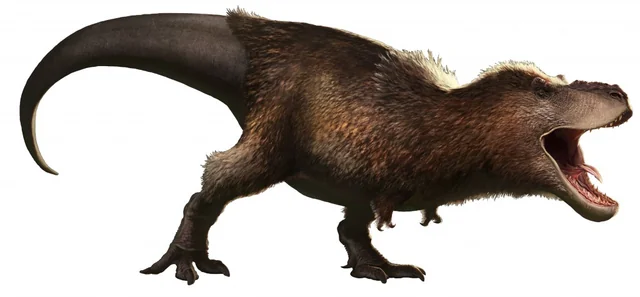
Adult Tyrannosaurus rex were likely mostly scaly, with no confirmed body-covering feathers, though small patches of simple filaments in juveniles or limited areas cannot be ruled out. No direct evidence exists for T. rex coloration, and bright purple or green plumage is unlikely because such hues usually require feather structures or pigments not yet documented for tyrannosaurids. Evidence from related species and preserved skin impressions points to muted, functional tones rather than tropical-bird displays for large tyrannosaurids.
What is the evidence that T. rex had feathers?
Skin impressions from several large, derived tyrannosaurids, including Tyrannosaurus, Albertosaurus, Daspletosaurus and Tarbosaurus, show small, pebbly scales in patches from regions such as the neck, pelvis and tail. A 2017 review of these impressions concluded that large tyrannosaurids likely had predominantly scaly skin, suggesting extensive body plumage had been reduced or lost by this stage of the lineage (Bell et al., 2017, Biology Letters).
Earlier tyrannosauroids did have feathers. The 125-million-year-old Yutyrannus, a giant relative about 9 meters long, preserved broad tracts of simple filamentous feathers (Xu et al., 2012, Nature). That shows insulation was present in the group’s history, but it does not prove feathers persisted in the largest, latest tyrannosaurids like T. rex.
Current fossils indicate: Yutyrannus had extensive simple feathers; adult T. rex and close relatives preserve scaly patches with no confirmed body plumage. Limited, localized filaments remain possible, especially in juveniles.
Two caveats temper any firm conclusion. First, skin and feather preservation is rare and patchy, so we may be missing integument types that were present but not preserved. Second, dinosaurs often combined scales and feathers on the same body, so the presence of scales does not exclude small feathered regions.
How do scientists infer dinosaur color?
In a handful of exceptionally preserved fossils, microscopic pigment-bearing structures called melanosomes retain shapes that correlate with specific colors in living birds.
Melanosomes are organelles that house melanin pigments. Sausage-shaped eumelanosomes are linked to blacks and grays, while rounder phaeomelanosomes relate to reddish browns.
This method revealed banded rust-and-white tail rings in Sinosauropteryx and a speckled, mostly dark plumage in Anchiornis (Zhang et al., 2010, Nature) and (Li et al., 2010, Science). It has also detected iridescent, glossy black feathers in Microraptor (Li et al., 2012, Science) and rainbow-like structural colors in the small theropod Caihong (Hu et al., 2018, Nature Communications).
However, many bright greens, yellows and purples in modern birds arise from structural coloration and carotenoid pigments that are harder to detect in fossils. Melanosome-based reconstructions bias results toward melanin colors, so absence of evidence is not evidence of absence. Crucially, there are no preserved T. rex feathers to analyze, so its color remains unknown.
Could a T. rex have been bright purple or green?
There is no direct evidence for vivid purple or green T. rex plumage. Those hues usually require either complex feather nanostructures that produce structural colors, or combinations of structural colors with carotenoid pigments. Evidence for such complex, display-oriented feathers exists in some small maniraptoran dinosaurs, but not in tyrannosaurids.
Biology also argues for restraint. Very large terrestrial animals tend to favor thermally practical and cryptic palettes, and the scaly skin documented in big tyrannosaurids suggests limited, if any, feather surfaces for showy coloration. While it is not impossible in principle that T. rex had small, brightly colored patches, there is no supporting fossil evidence today.
Why are big tyrannosaurids scaly if some relatives were fuzzy?
The pattern fits an evolutionary and ecological shift. Early tyrannosauroids like Yutyrannus lived in cooler climates and bore insulating filaments. As tyrannosaurids grew larger and occupied different environments later in the Cretaceous, their surface-to-volume ratios and heat balance changed, reducing the need for blanket-like insulation. The simplest interpretation of current fossils is secondary loss or reduction of widespread feathers in large-bodied tyrannosaurids (Bell et al., 2017).
Preservation bias still matters. Feathers fossilize best in fine-grained settings, which rarely preserve large tyrannosaurids. Finds like feathered Ornithomimus in sandstone show that exceptions occur, but until comparable evidence turns up for tyrannosaurids, scaly adults with at most localized filaments remain the supported model.
What have we actually learned about dinosaur colors so far?
- Melanin-based colors are documented: blacks, grays, browns, and rufous tones in multiple small theropods (Li et al., 2010).
- Iridescence and structural color are confirmed in small, birdlike dinosaurs such as Microraptor and Caihong (Li et al., 2012); (Hu et al., 2018).
- Countershading for camouflage is demonstrated in the horned dinosaur Psittacosaurus, implying habitat lighting shaped its color pattern (Vinther et al., 2016, Current Biology).
None of these data include T. rex, because no feathers are preserved for it. If future discoveries find T. rex filaments with preserved melanosomes, scientists could test its colors directly.
Bottom line
Based on current fossils, adult T. rex were primarily scaly, not fully feathered. Juveniles may have had sparse, simple filaments, but bright, parrot-like plumage is unsupported. Color evidence from other dinosaurs shows mostly melanin-based tones and, in some small species, iridescence. Until new specimens are found, a muted, functional appearance is the most evidence-based reconstruction for T. rex.