
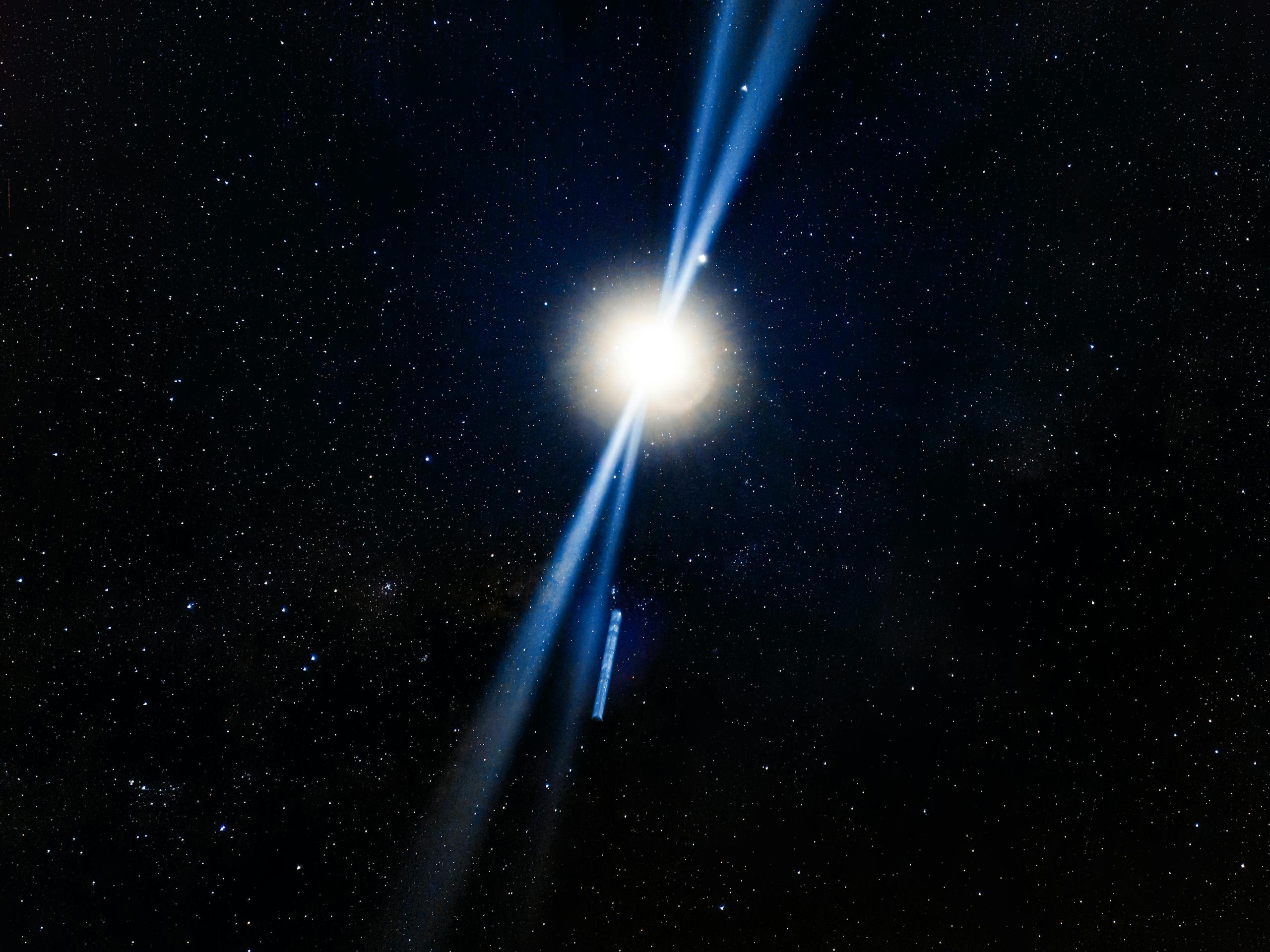
Cosmic rays are not a special new kind of particle. They are mostly high-energy charged particles, primarily protons and atomic nuclei, that originate in space and strike Earth. Photons like X-rays and gamma rays are typically classified separately as electromagnetic radiation, not as cosmic rays.
What is a cosmic ray?
A cosmic ray is a high-speed particle arriving at Earth from beyond its atmosphere. The vast majority are protons, with a smaller fraction of helium nuclei and trace amounts of heavier nuclei and electrons. In particle-physics terms, they are the same species of particles we study on Earth, just accelerated to very high energies in space.
Cosmic rays are about 90 percent protons, 9 percent helium nuclei, and roughly 1 percent heavier nuclei, with a small contribution from electrons and antimatter such as positrons and antiprotons (Encyclopaedia Britannica, Particle Data Group).
Physicists distinguish primary cosmic rays, which arrive from space, from secondary cosmic rays, which are particles created when primaries collide with atoms in the atmosphere and generate particle cascades.
Are X-rays and gamma rays cosmic rays?
No. Although early researchers called the phenomenon “rays,” cosmic rays today specifically means charged particles. High-energy photons are called gamma rays or X-rays depending on their origin or energy range, even if they come from space. You will often see phrases like “cosmic gamma rays” or “cosmic X-rays” to indicate their origin, but in physics they are not grouped under cosmic rays. This narrower usage is standard in modern references and observatories (CERN, Britannica).
In contemporary usage, “cosmic rays” refers to energetic charged particles from space, while high-energy photons from space are categorized as gamma-ray or X-ray astronomy targets (CERN).
Where do cosmic rays come from?
Their “cosmic” label reflects origin outside Earth, not a unique particle type. Sources span several regimes:
- Solar energetic particles (SEPs): Charged particles accelerated by solar flares and coronal mass ejection shocks. These are generally lower energy than most galactic cosmic rays but can cause radiation storms near Earth (NOAA SWPC).
- Galactic cosmic rays (GCRs): Believed to be accelerated primarily in supernova remnants through diffusive shock acceleration. These dominate the background of high-energy particles in interplanetary space (Britannica).
- Extragalactic and ultra-high-energy cosmic rays (UHECRs): Rarer, extremely energetic particles likely originating from active galactic nuclei, radio galaxy jets, or gamma-ray bursts. Their precise sources are an active research area (PDG review, Pierre Auger Observatory).
By convention, the slow solar wind plasma is not called cosmic rays. The term applies to the comparatively high-energy tail of charged particles that can penetrate Earth’s magnetic field and atmosphere.
How energetic are cosmic rays?
Cosmic-ray energies span a vast range, from millions of electron volts to more than 10^20 electron volts. The highest-energy events observed in nature exceed what the Large Hadron Collider achieves per particle.
- LHC scale comparison: A ~10^17 eV proton striking a stationary proton in the atmosphere produces a center-of-mass energy comparable to a 14 TeV LHC collision. Nature produces many events at and above this scale (CERN).
- UHECR record: Several observatories have detected events above 10^20 eV, a regime that challenges models of how particles are accelerated to such energies (PDG).
How do cosmic rays interact with Earth?
When a primary cosmic ray hits the upper atmosphere, it collides with a nucleus and initiates an air shower, producing pions, kaons, photons, and other secondaries. Many pions decay into muons, which are penetrating and can reach the ground.
- Surface flux: Roughly one muon per square centimeter per minute reaches sea level on average, a standard benchmark used in detector calibrations (CERN).
- Detectors: Space-based instruments like AMS-02 on the International Space Station measure primaries above the atmosphere. Ground arrays and fluorescence telescopes, such as the Pierre Auger Observatory, reconstruct ultra-high-energy air showers.
- Impacts: Cosmic rays contribute to radiation dose on aircraft and in space, can flip bits in electronics, and are used beneficially in muography to image volcanoes and infrastructure.
Bottom line: Is the definition about origin or particle type?
Both. Cosmic rays are defined by their origin beyond Earth and by being charged particles, not photons. An X-ray or gamma-ray from space is classified as electromagnetic radiation, not a cosmic ray. A proton from a supernova remnant or a solar energetic event is a cosmic ray. The particles themselves are familiar, what makes them notable is their energy and where they come from.