The Island That Ate Itself: Nauru’s Highs and Ruin
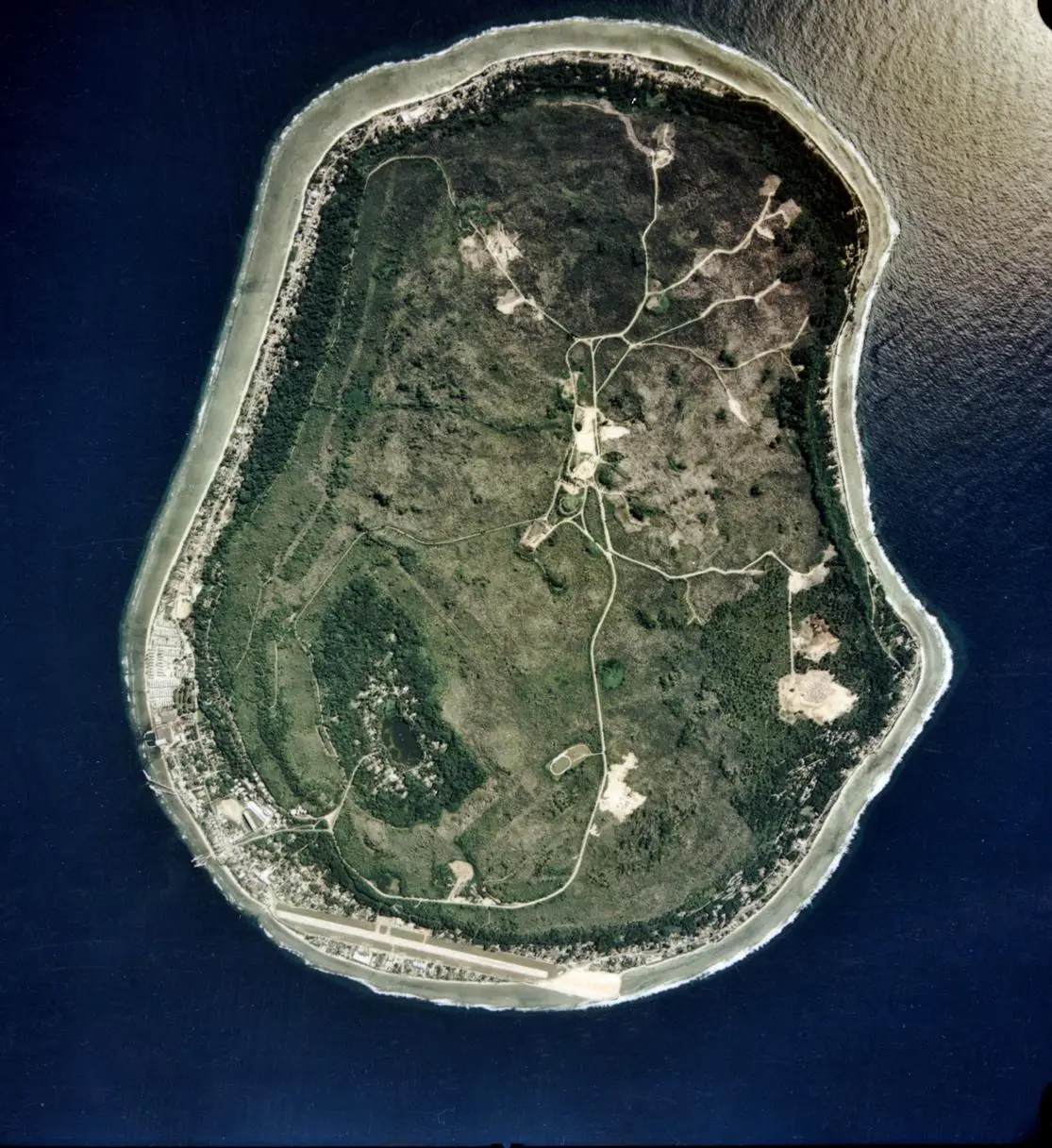
This is Nauru, a nation of about 11,000 people on 21 square kilometers of coral in the western Pacific. In living memory it went from one of the world’s richest countries per person to a cautionary tale, a modern parable of how fast a windfall can become a reckoning.
The phosphate century
The story begins with birds. For millennia, seabirds fed in the rich Pacific and returned to roost on Nauru. Their guano hardened into phosphate rock, a fertilizer that would supercharge 20th century agriculture. Colonial powers began shipping the phosphate in the early 1900s. Nauru took control after independence in 1968, and for a time the money was astonishing. The island had no income tax, free health care, free education, and overseas investments from Melbourne to Suva.
Phosphate mining was also devastating. Roughly 80 percent of the island’s land was stripped. The central plateau became a maze of coral pinnacles up to 15 meters high. Only a narrow coastal fringe remained fertile. Fishing grounds were damaged by runoff. The wealth was finite, the damage lasting.
Fortunes made, then lost
Nauru tried to turn its mineral cash into a future by buying assets abroad through the Nauru Phosphate Royalties Trust. Some became landmarks. In Melbourne, the 52 story Nauru House rose over Collins Street, briefly the tallest tower in the city. Other bets fared worse. The Grand Pacific Hotel, an Edwardian grande dame on Suva’s waterfront, fell into disrepair. When Fiji’s patience ran out in 2000, Prime Minister Mahendra Chaudhry put it starkly.
“We have taken possession of the hotel. It is part of our national heritage. We cannot allow it to go to ruin and be a blight on our foreshore,” Chaudhry said.
Assets were sold to service debts. A trust that once counted its value in the billions dwindled. The New York Times would later sum up the collapse with a barbed shorthand, calling it “The Billion-Dollar Shack.”
After the music stopped
When the high grade phosphate ran out in the 1990s, the economy unraveled. Government services faltered. Imported food replaced subsistence gardens, a shift that helped drive some of the highest rates of obesity and diabetes in the world. The banking system buckled. For a time Nauru became a tax haven. Then another source of income arrived, as Australia began paying Nauru to host an offshore processing center for people seeking asylum by boat.
International scrutiny followed. Journalists and doctors reported acute mental health crises among children and adults in detention. Amnesty International called the conditions “a horror,” accusing Australia of outsourcing its obligations while Nauru, in need of money and jobs, kept the gates.
What rehabilitation means on a mined-out atoll
Rehabilitation has always been the hardest line in the ledger. Replanting Topside requires trucking in soil to cover sharp limestone, then nurturing vegetation on a blasted karst. An out of court settlement with Australia acknowledged the colonial era damage, but restoring a living ecosystem is a different bill altogether, measured in decades of labor rather than legal briefs.
Even if Topside is partially reclaimed, climate change now layers a second threat. Nauru’s villages sit on a coastal ring no more than a few hundred meters wide. Sea level rise, stronger storms, and saltwater intrusion pressure the island’s freshwater, roads, and homes. The problem is not distance to high ground, it is that high ground is skeletal rock.
The next bet: metals from the abyss
Faced with few options, Nauru has looked offshore again, this time to the deep Pacific. Partnering with a Canadian company, it moved to accelerate global rules for harvesting polymetallic nodules that sit four kilometers down, potato sized rocks rich in cobalt, nickel, copper, and manganese. Proponents say these metals are crucial for batteries and the energy transition. Critics warn that scraping the ocean floor could damage fragile ecosystems we barely understand. For a country that has lived the arc from extraction to aftermath, the choice is not abstract. It is a balance of survival, sovereignty, and the precautionary principle.
Lessons from a small country
Nauru’s story is not a fable about greed alone, and certainly not a morality play about a people undeserving of wealth. It is a composite of extraction economics, small state vulnerability, and the physics of an island where land is finite. Powerful outside actors profited for decades before independence. Local leaders made bold moves, some visionary, some ruinous. Good years encouraged spending that assumed tomorrow would resemble yesterday. Then the rock ran out.
Look again from the ring road. The sea is a perfect blue, the reef flat flashes silver with schooling fish, and children race along the verge on bikes. Beyond them the limestone spires of Topside catch the light. They are monuments now, to what birds built, to what people took, and to the cost of believing that a windfall lasts forever.