
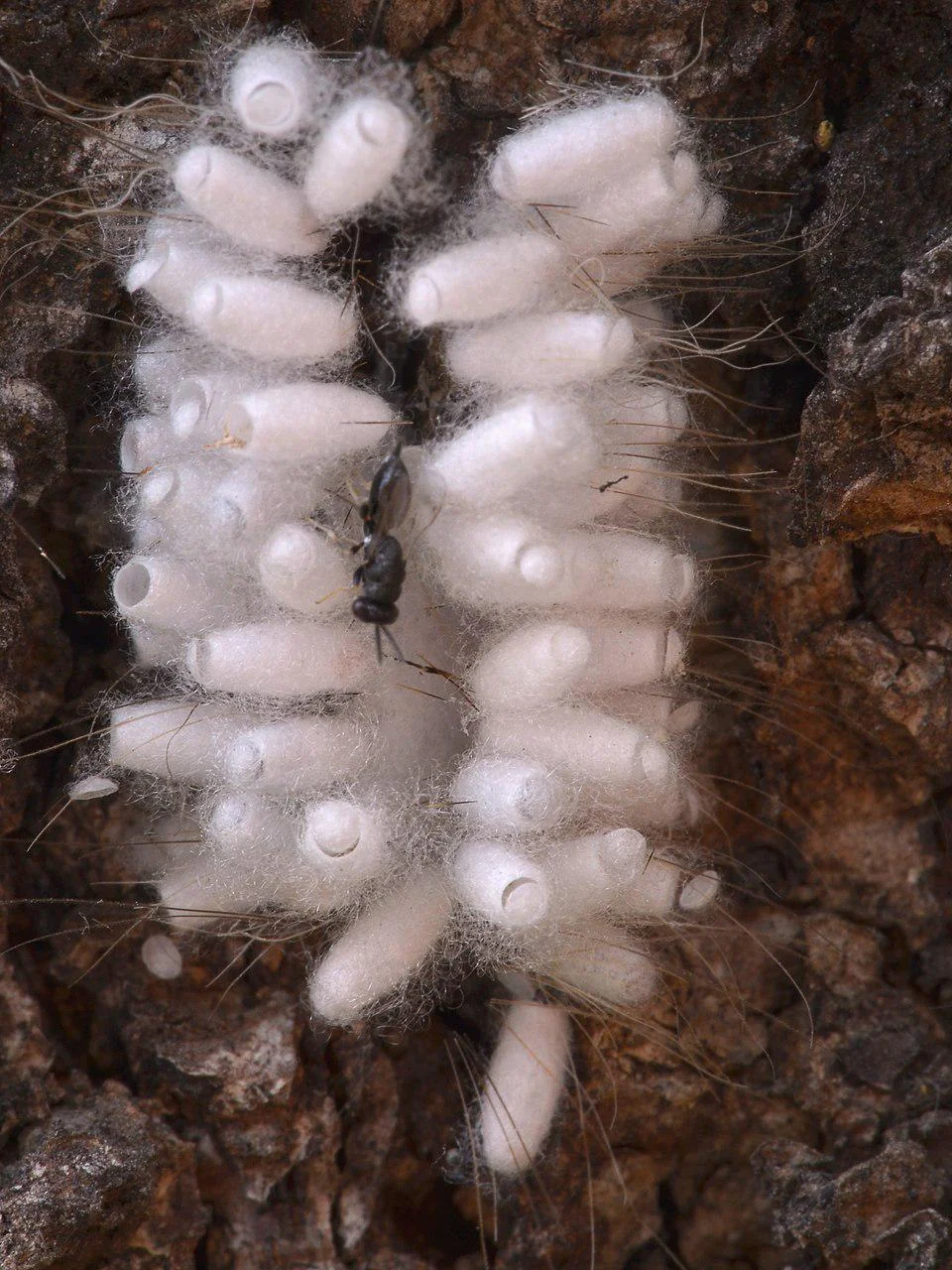
The cabbage leaf hardly moves, yet a small drama is underway. A caterpillar inches along the midrib. A slender black wasp lands, curls her abdomen and touches it lightly to the caterpillar’s skin. Inside the larva, her eggs will hatch and begin to feed. Days later, a cluster of pale cocoons appears on the leaf like a spill of pearls. Then another wasp arrives, smaller still, seeking those cocoons. The hunter has a hunter.
When parasites become prey
The second wasp has a job description most of us never learned in school: hyperparasite. Where a parasite makes a living at the expense of a host, a hyperparasite lives on or in a parasite. That stacked arrangement can stretch even further. Insects, fungi and microbes sometimes form chains of exploitation that run three or four links deep. The biology is nested like a set of wooden dolls: a life inside a life inside a life.
In farm fields and laboratory growth chambers, these dynamics are more than curiosities. They shape who eats what, how diseases spread and, in some cases, how we control the organisms that afflict our crops and our bodies.
Wasps, caterpillars and the double life of a field
Consider the cabbage whites that nibble through brassica leaves each summer. They attract the attention of Cotesia glomerata, a small parasitoid wasp that injects eggs into the caterpillars. The wasp larvae develop inside, eventually emerging to spin silken cocoons on the outside of the host. But those cocoons do not sit unguarded for long. Hyperparasitoid wasps such as Lysibia nana search them out and lay their own eggs, turning the developing parasitoids into food.
Plant biologists have shown that this is not just a two- or three-player interaction. Parasitism changes the chemistry of the plant being eaten. In work led by researchers at Wageningen University, plants attacked by parasitized caterpillars emitted different bouquets of volatiles than plants attacked by unparasitized ones. Hyperparasitoids cued in to those altered scents, homing to spots where their targets were most likely to be found. The plant had not meant to send a signal that would sabotage the natural enemies of its herbivore. But ecology has few clean battle lines. The scent that calls for help can also call for trouble.
Hyperparasitoids add a second ceiling to the food web. If their numbers are high, they can suppress the primary parasitoids that farmers sometimes depend on to keep crop pests in check. If their numbers are low, parasitoids can thrive and so can biological control. In these systems, timing is everything: when flowers bloom, when volatiles peak, when cocoons are laid. A week either way can tip the balance.
Fungi that hunt fungi
Hyperparasitism is not limited to insects. In greenhouses and vineyards, a microscopic fungus called Ampelomyces quisqualis invades the white, dust-like growth of powdery mildew fungi that parasitize plants. Ampelomyces slips into the mildew’s hyphae and fruiting bodies, consuming the parasite from within. Growers have learned to deploy this relationship to their advantage. A commercial biofungicide sold under the name AQ10 contains a strain of Ampelomyces that colonizes powdery mildew outbreaks on crops such as grapes and cucurbits. The product works because it is a parasite of a parasite.
Mycoparasites like Ampelomyces illustrate a key ecological point. A hyperparasite can blunt the impact of a primary parasite and in doing so protect the host. Yet outcomes are rarely uniform. Temperature, humidity and the timing of infection can push the same trio of organisms toward very different results. In some seasons, mycoparasites arrive late and make only a dent. In others, they sweep through and the mildew collapses.
Viruses inside parasites
The nesting continues deeper in the microscopic world. In 2011, researchers reported that some strains of Leishmania, a protozoan parasite transmitted by sandflies, carry their own viral passengers. The virus, known as Leishmania RNA virus, does not infect human cells directly. Instead it replicates inside the parasite that infects us. Patients harboring Leishmania strains that carry the virus are more likely to develop severe mucocutaneous disease, a disfiguring form of leishmaniasis. The hyperparasite shifts the disease landscape by changing the behavior of the parasite it rides.
Microbes that parasitize parasites are not just curios found in a handful of tropical diseases. Insects around the world host the bacterium Wolbachia, which manipulates reproduction in ways that help it spread. Wolbachia itself is host to a bacteriophage called WO. A virus in a bacterium in an insect: a matryoshka of infection that demonstrates how biological rules repeat across scales.
What hyperparasites teach us
Ecologists have long suspected that hyperparasites act as governors in living systems. By attacking parasites that would otherwise run amok, they can reduce outbreaks and temper virulence. There is evidence for the opposite as well. Competition among parasites and their hyperparasites inside a single host can drive an arms race, selecting for faster replication and more damage. The direction depends on context: which species are involved, when they meet, what the environment is doing at the time.
That ambivalence is not a flaw. It is a reminder to tread carefully when we try to harness hyperparasites. Biological control programs that release parasitoid wasps to reduce crop pests can be undermined if local hyperparasitoids quickly find and exploit the new arrivals. Planting strips of nectar-rich flowers can support beneficial wasps, yet the same habitat can also boost the hyperparasitoids that attack them. Decisions that look simple on paper often rest on seasonal field trials and the kind of local knowledge gained by walking the rows.
Medicine is another frontier. The discovery of viruses inside human parasites has prompted researchers to ask whether targeting the virus could blunt disease without directly attacking the parasite. In leishmaniasis, that idea is being explored in the lab. It is a delicate proposition. Knock out a hyperparasite and you may inadvertently strengthen its host. In other cases, removing the viral passenger could make the parasite less inflammatory and therefore less damaging. The same pattern of trade-offs that frustrates farmers also greets clinicians.
How deep does it go
Tertiary and even quaternary parasitoids have been recorded in some insect systems, a reminder that evolution is not sentimental about where it finds a niche. Popular culture talks about food chains, but living networks are really webs. They flex and tighten, they have corners no one notices until something tugs on them.
So, Naturalists observe, a Flea
Hath smaller Fleas that on him prey,
And these have smaller yet to bite ’em,
And so proceed ad infinitum.
Jonathan Swift published those lines in 1733, long before anyone named a hyperparasitoid wasp. The rhyme endures because the image is true. Life builds on life, and not only in harmonious partnerships. Some of the most intricate relationships are parasitic all the way down, yet even those can stabilize ecosystems, feed predators we value or open doors to new kinds of therapy.