
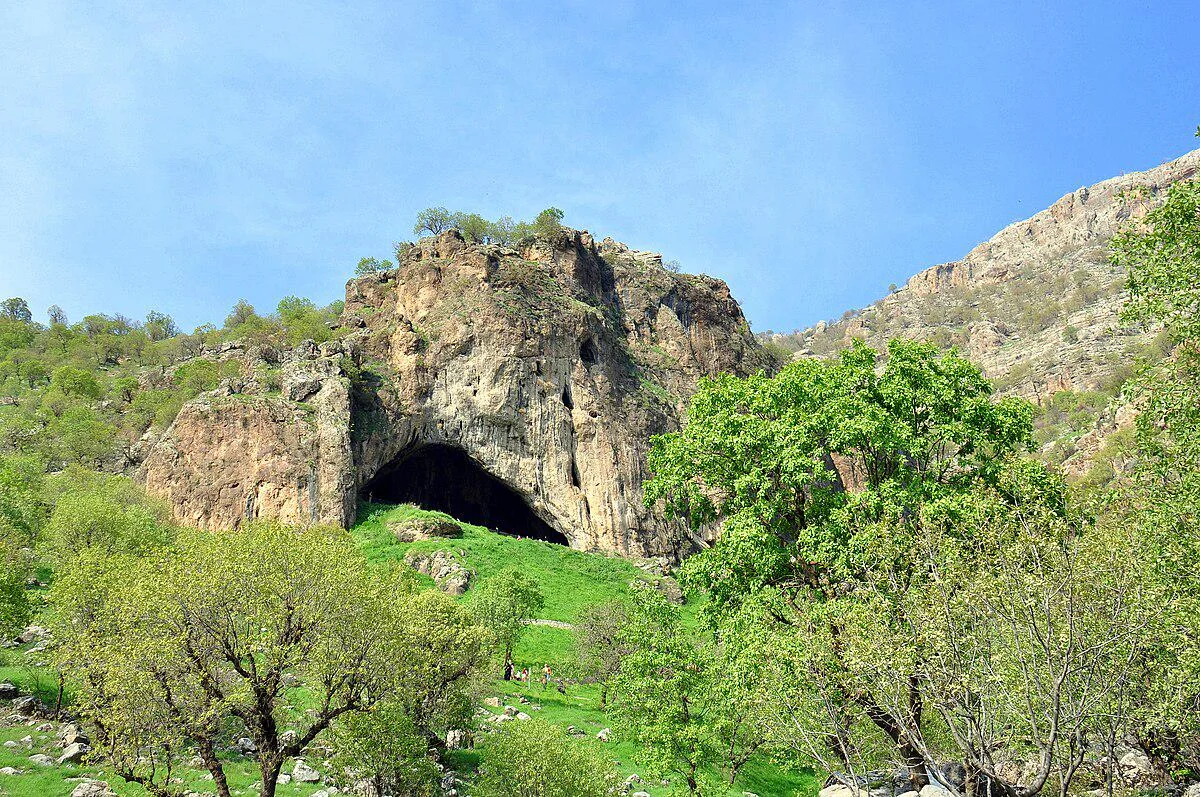
The cave opens like a dark mouth in the limestone of the Zagros Mountains, high above the Great Zab River. In this rock shelter in northern Iraq, archaeologists found a Neanderthal who should not have been alive and yet was. His bones tell a story of injury, repair and, most strikingly, other people.
Shanidar Cave is a storied place in paleoanthropology. Excavated in the late 1950s and early 1960s by Columbia University archaeologist Ralph Solecki, it yielded a cluster of Neanderthal skeletons that would shape decades of debate over how our close cousins lived and died. Among them was Shanidar 1, an older adult male by Ice Age standards, likely in his forties or fifties. He is known not for a dramatic death, but for how long he lived after suffering traumas that would have made daily life hard to navigate alone.
The body that outlived its injuries
Shanidar 1’s face records a violent blow that crushed the bones around his left eye. The fracture would likely have left him partially or totally blind on that side. Inside his skull, the bony walls of the ear canals show growths known as exostoses, which narrowed and, on one side, essentially closed the passage. This kind of remodeling is associated with profound conductive hearing loss. The right forearm is gone, the bone truncated above the elbow with signs of healing and remodeling that indicate he survived the trauma or amputation long afterward. Elsewhere, his skeleton shows degenerative changes in the feet and spine that come with age and long use, and several healed injuries consistent with a life filled with hazards.
These observations come from careful anatomical study, not guesswork. Teams led by specialists including Washington University anthropologist Erik Trinkaus have described the ear canal changes and their implications for hearing. The facial injury is visible in the orbit, where the broken margins tell of a forceful impact and a healed, asymmetric outcome. The shortened arm shows rounded bone ends and remodeling that do not occur in a fresh break, only over months and years of survival. None of this, on its own, tells us what he felt or thought. Taken together, it does say something about how he lived and who stood beside him.
What survival implies
Injuries are common in Ice Age skeletons. Survival with multiple disabling conditions is not. A person with severe unilateral blindness, profound hearing loss and one arm would have struggled to hunt, knap stone, carry fuel, or keep warm and fed in winters that could chill bone. Yet Shanidar 1 lived on, long enough to manifest the slow burdens of age. The implication many researchers draw is not sentiment, but logistics: someone must have helped. Help can mean shared food, a protected spot by the fire, company on the move, shelter in storms and hands to dress wounds. It can also mean roles shifted to fit his abilities, perhaps processing hides or performing tasks that rely on knowledge rather than speed or strength. Heavy wear on his front teeth suggests he sometimes used them as a vice, consistent with gripping and softening hides.
Scientists are cautious about projecting modern emotions onto ancient minds. They cannot measure compassion in a fossil. What they can measure is time, bone remodeling and the functional limits imposed by injuries. If those limits would likely preclude solitary survival, then the continued presence of a person is circumstantial evidence of social support. That does not romanticize the past. It recognizes that for Neanderthals to thrive in harsh environments, cooperation was not optional.
Not an isolated case
Shanidar 1 is part of a wider pattern. At La Chapelle-aux-Saints in France, an elderly Neanderthal male, discovered in 1908, had lost many teeth and suffered severe arthritis, yet he, too, lived long enough to show extensive bone remodeling. Far earlier in time, in the site of Dmanisi in Georgia, a 1.8 million year old Homo erectus individual was found effectively toothless, the sockets resorbed. Survival without chewing teeth implies soft foods and social provisioning. Across species and landscapes, the archaeological record keeps turning up people who outlived injuries and impairments, which implies that someone fed, protected and valued them.
Taken together, these cases indicate that the social safety net has ancient roots. It was likely woven from obligations and reciprocity, from kinship and skill, rather than abstract ethics. Still, its effect would look familiar today: those who could not fully fend for themselves were not simply left behind.
Reassessing Neanderthals, cave by cave
Neanderthals have long been caricatured as brutish. Over the past two decades, that picture has softened and sharpened at once. We now know they made adhesives, lit fires, hunted large game with close-range weapons and likely managed complex landscapes for tens of thousands of years. They interbred with ancestors of many living people outside Africa, leaving a genetic legacy. None of this makes them modern humans, but it does situate them as close relatives with their own traditions and solutions.
Shanidar Cave sits at the center of that reevaluation. Solecki famously argued that pollen around one skeleton indicated a ritual “flower burial,” an interpretation that later studies questioned, noting that burrowing rodents may have carried the flowers. Decades after the original work, an international team returned to the cave with modern methods. In 2020, researchers led by Chris Hunt of Liverpool John Moores University reported a new partial skeleton, informally known as Shanidar Z, placed within a scoop in the cave floor. The context strengthens the case that at least some Neanderthals at Shanidar were deliberately buried, even if the flowers remain uncertain. The new excavations have also refined dating and site formation, building a more nuanced view of who used the cave, when and how.
That ongoing work does not settle every debate. It does press the field toward specific, testable claims drawn from sediments, bones and context rather than sweeping generalizations. In that sense, Shanidar 1’s power lies in particulars. A crushed eye socket that healed. Ear canals closed by bone. A forearm gone, the stump remodeled, the person still alive years later. These are concrete traces, not metaphors.
How scientists see what bones can say
Much of the public fascination with cases like Shanidar 1 turns on a straightforward question: how can anyone tell? The answers are unglamorous and exacting. Blunt force trauma to the face leaves diagnostic fracture patterns that differ from damage after death. Ear canal exostoses are irregular bony outgrowths that can be measured, their size and shape compared to clinical cases. Amputation or traumatic loss of a limb is visible in the rounded, remodeled ends of long bones and in the changing shape of muscle attachment sites. Patterns of tooth wear and chipping tell of diet and the use of the mouth as a tool. Arthritis and other degenerative changes follow recognizable paths across joints and vertebrae.
Researchers assemble those observations, layer them with dating and site context, and ask what kinds of behavior would have made survival likely or unlikely. The process is meticulous, sometimes slow and often contested. When the picture holds up under new scrutiny, it earns its place in the narrative.
The oldest kind of safety net
If Shanidar 1 had been found alone, he might read as an anomaly. Found among others in a site used repeatedly across millennia, he reads as a person among people, one whose life depended on the predictable presence of others. Whether those others were kin, bandmates or some mix hardly matters for the essential point. In a cold cave above a mountain valley, someone cooked enough food to share, kept a fire going, fashioned a sling or a support, slowed down so that he could keep pace. Someone decided he was worth the work.
That decision does not require modern language for empathy. It requires a practical recognition that groups are stronger when they keep experience and knowledge alive, that members matter beyond what they can lift or carry in any given week. In this, the Neanderthals at Shanidar look less like alien cousins and more like us at our best, improvising care with whatever the day and the season allow.