
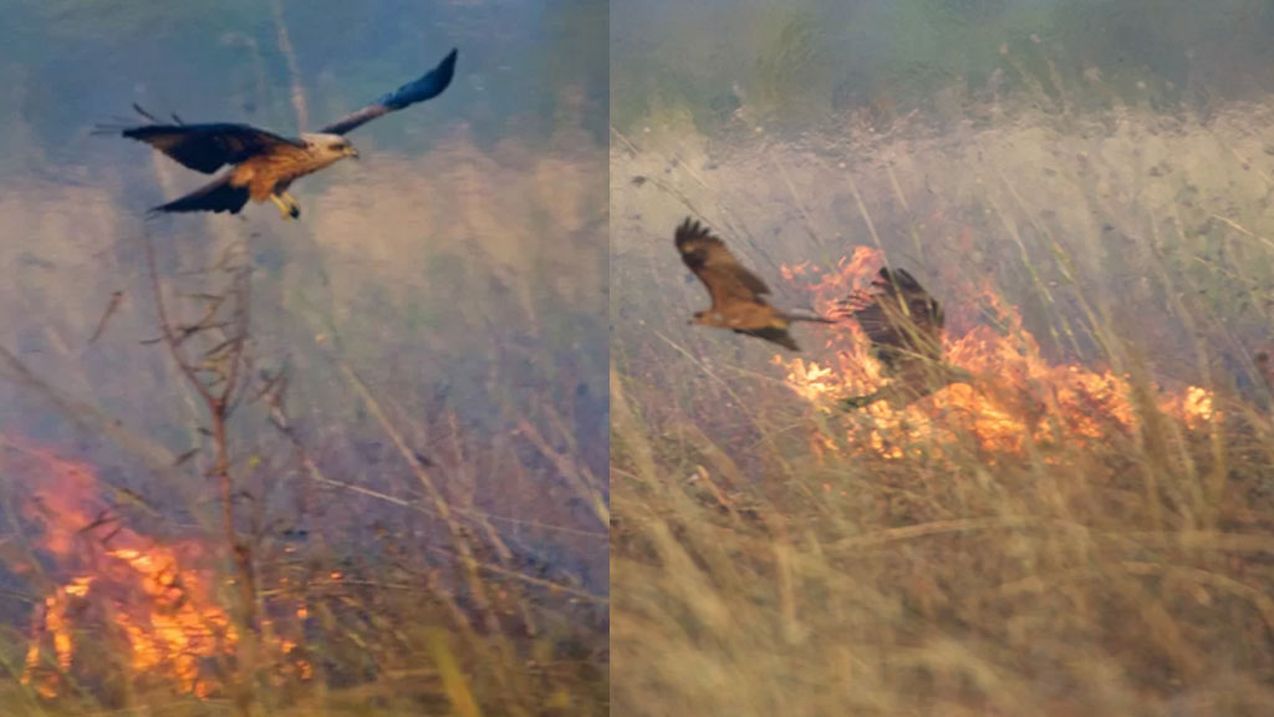
They are not mythical phoenixes, and they are not a social-media hoax. In Australia’s tropical savannas, several raptor species have been documented picking up burning sticks and dropping them into unburned grass to flush prey. Fire, in other words, is another tool in a hunter’s kit.
For generations, Aboriginal Australians have described these “firehawks” and built their knowledge into ceremony and land care. Over the past decade, scientists worked with Indigenous rangers and land managers to record the behavior systematically. What they found challenges old assumptions about animal intelligence and carries real consequences for how we fight and live with fire.
An ancient observation, tested by modern science
In 2017, researchers led by anthropologist Mark Bonta and ornithologist Robert Gosford published a study in the Journal of Ethnobiology drawing together eyewitness accounts from Indigenous experts and non-Indigenous observers across northern Australia. The paper describes three species engaged in fire-spreading: the Black Kite (Milvus migrans), the Whistling Kite (Haliastur sphenurus), and the Brown Falcon (Falco berigora).
“Observers report both solo and cooperative attempts, often successful, to spread wildfires intentionally via single-occasion or repeated transport of burning sticks in talons or beaks.”
That finding, the authors note, aligns with Indigenous Ecological Knowledge from the Northern Territory and beyond, where the behavior is widely known and even represented in sacred ceremonies. Documenting it required long-term collaboration: fieldwork with rangers, ethno-ornithological workshops, and careful gathering of reports from Western Australia, the Northern Territory, and Queensland. A feature from Penn State Altoona, where Bonta teaches, describes the work as an ongoing partnership designed to rigorously test and share what local people have long observed.
How birds move fire, and why it works
Fire-spreading is opportunistic. Raptors do not conjure flame from scratch; they exploit smoldering edges, burning grass tussocks, or sticks already alight. An individual kite or falcon will grasp a burning twig in its beak or talons, carry it tens to hundreds of meters, and drop it into unburned fuel. If the fire catches and runs, the birds position themselves along the flank, picking off insects, lizards, small mammals, and other creatures that flee the advancing line.
In open savanna, this strategy pays. Northern Australia’s grassy landscapes are famously fire-prone, with long dry seasons, quick-drying fuels, and wind that can carry embers with ease. Prey species depend on cover; remove that cover quickly, and a raptor gains the advantage. Observers have reported multiple birds working the same front, apparently repeating the stick-carrying behavior to keep the flush going.
While dramatic, the behavior sits within a broader pattern of animals using cause-and-effect to forage. Corvids, for instance, have demonstrated an understanding of water displacement in controlled experiments, dropping objects into a vessel to raise the liquid level and reach a reward. Whether moving water or moving fire, the underlying thread is problem-solving in pursuit of food.
- Key species: Black Kite, Whistling Kite, Brown Falcon
- Typical setting: dry-season savannas with active or recent fires
- Goal: flush concealed prey from grass cover
- Method: transport a smoldering or burning stick, drop into unburned fuel, capitalize on the flush
What this means for fighting and living with fire
The practical implications are immediate. Land managers conducting prescribed burns in northern Australia already reckon with spot fires caused by windborne embers; a raptor carrying fire across a line can produce the same effect. Aboriginal ranger groups and experienced firefighters have learned to anticipate this, especially under gusty conditions when fuels are cured.
“Though Aboriginal rangers and others who deal with bushfires take into account the risks posed by raptors that cause controlled burns to jump across firebreaks, official skepticism about the reality of avian fire-spreading hampers effective planning for landscape management and restoration.”
That caution, from the Journal of Ethnobiology paper by Bonta and colleagues, points to a policy gap. If planning frameworks do not acknowledge the possibility of avian-assisted spotting, they may underestimate risk and resource needs during operations. Simple adjustments—additional patrols downwind, timing burns to cooler periods, coordinating closely with local Indigenous ranger groups—can reduce the chance that a flock of kites turns a line into a leap.
There is also an ecological dimension. Fire is an ancient force in Australia’s savannas, shaping plant communities and wildlife behavior. Many native species are adapted to frequent burning, and cultural burning practices have long used fine-scale, cool fires to create mosaics that limit extreme blazes. Recognizing birds as sometimes-active agents in that firescape adds nuance to models of ignition and spread, especially in a warming climate that stacks the deck for longer dry seasons and more volatile fuel conditions.
Rethinking animal intelligence and the tools of predation
Where does carrying a burning stick fit on the spectrum of animal cognition? The behavior is clearly more than a reflex: it requires seeking out an ember, transporting it while avoiding injury, and deploying it where it will do the most good. It is not the invention of fire, but it is the manipulation of a natural phenomenon to produce a desired outcome—much as many species use stones, thorns, or water to the same end.
Framed that way, “firehawks” force a tidy reframing. Intelligence in the wild is not a ladder with humans on top; it is a toolkit honed by pressure and opportunity. When flames run across the grass and protein scatters in panic flight, a raptor that can make the flames run a little farther wins a meal. The stakes are elemental, the calculation precise, and the lesson humbling.
What comes next
Researchers continue to work with Indigenous experts and fire managers to refine what we know: how often the behavior occurs, which conditions favor it, and how to distinguish true stick transport from the countless ember-driven spot fires that happen without avian help. The Journal of Ethnobiology study notes that workshops and controlled field experiments with land managers are part of that effort, aiming to evaluate risk and embed the knowledge where it matters most—on the ground.
For communities across northern Australia, the imperative is practical. Incorporating avian fire-spreading into burn plans costs little and may prevent headaches when birds are thick along a fire front. For the rest of us, the story is a reminder that insight does not always arrive first in a lab or a city desk. It often lives in Country—in languages, songs, and practices that carry the memory of landscapes watched closely over time.
Fire remains a dangerous ally. We corral it with legislation and hoses; raptors carry it in beaks and claws; plants sprout after it passes. To see a kite lift a coal and ride a thermal is to witness an old contract between hunger and heat. Respecting that contract—by listening, learning, and planning accordingly—may be the most modern thing we can do.